
Artikel: How to Frame Art Prints in 4 Easy Steps

How to Frame Art Prints in 4 Easy Steps
This article is part of our Guide to Buying Fine Art Prints.
Framing is where an art print becomes a finished object.
The print itself matters first: the paper, the image quality, the ink, and the process. But framing changes how the piece lives in a room. It affects the look, the protection, the scale, and even how easy the artwork is to hang.
That is why framing should not be an afterthought.
Before you choose a frame, think through four things: the frame style and color, the glazing, the matting, and the hanging hardware.
In brief: To frame an art print well, choose a frame style and color that suits the artwork, pick the right glazing, decide whether the print needs a mat, and check the hanging hardware. Good framing should make the print look finished, protect it, and suit the room where it will live.
Step 1: Choose the Frame Style and Color
The frame should support the artwork, not fight it.
For most buyers, the easiest starting point is to ask whether the print feels more classical or more modern.
Classical works often look good in warmer, more traditional frames: gold, dark wood, walnut, black with a decorative profile, or something lightly ornate. This can work especially well for old master reproductions, academic paintings, Orientalist works, botanical prints, classical landscapes, and art that already carries a historical or formal feeling.
Modern works often suit cleaner frames: black, white, natural wood, slim profiles, or simple box frames. This usually works well for photography, Bauhaus prints, Japanese woodblocks, abstract art, modernist works, graphic posters, and interiors where you want the frame to feel quiet and architectural.
That does not mean the rule is absolute.
A classical work in a clean black frame can look sharp and contemporary. A modern print in a gold frame can look deliberate and interesting. But if you are unsure, the simplest rule is this:
Traditional art usually tolerates more decorative framing. Modern art usually benefits from restraint.
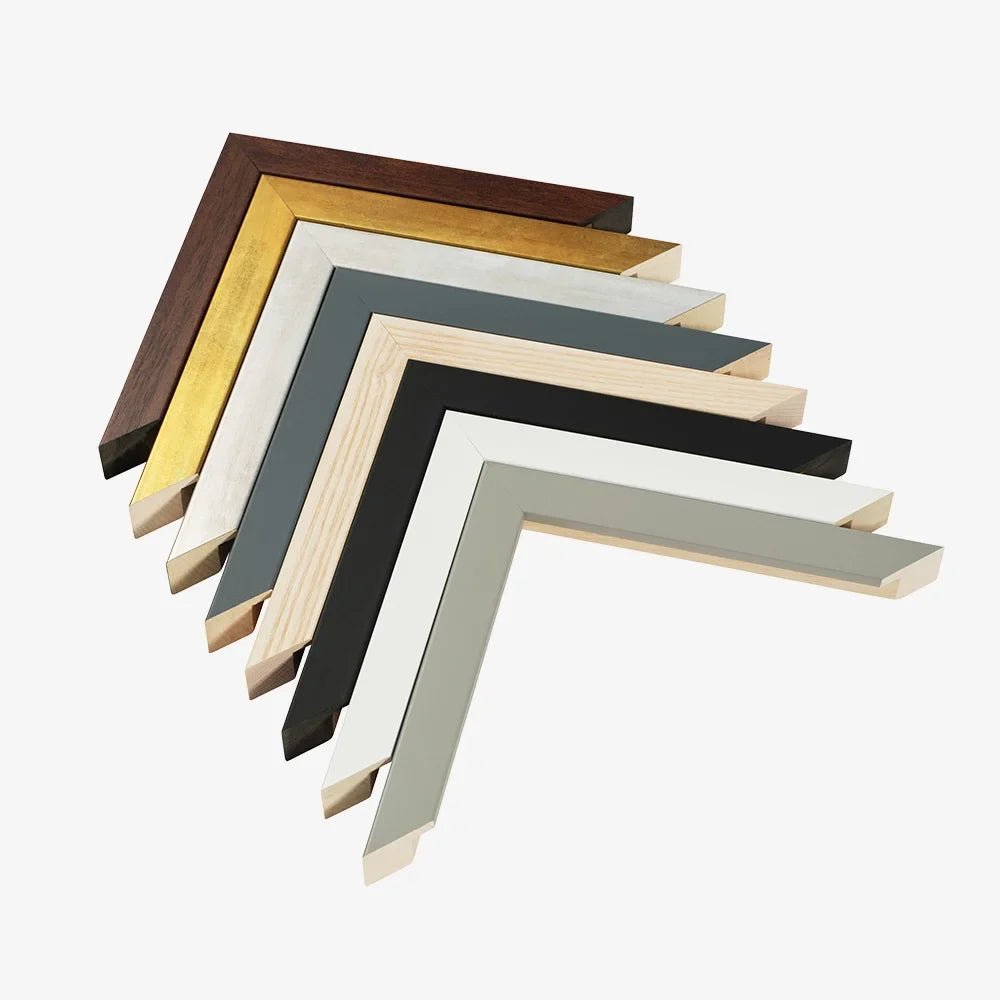
Choosing Frame Color

Frame color matters almost as much as frame style.
- Black frames are graphic, versatile, and especially good for modern works, Japanese prints, photography, and strong compositions.
- White frames feel lighter and more contemporary, especially in bright rooms or minimal interiors.
- Natural wood frames add warmth and are useful when a black frame would feel too severe.
- Walnut or brown frames add warmth, depth, and a slightly traditional feel, making them especially good for landscapes, botanical prints, classical works, and rooms with wood furniture or warmer tones.
- Gold frames can make classical works, portraits, landscapes, and historical reproductions feel more formal and expensive.
- Silver frames can work well for Regency-inspired interiors, cooler palettes, black-and-white photography, Art Deco references, or old Hollywood-style posters.
- Ornate frames can elevate traditional art, but they should be used with care. Too much frame can overpower the print.
The frame does not need to match every object in the room. It only needs to make visual sense with the artwork and the space around it.
If the room is already busy, choose a calmer frame. If the artwork is very quiet, a stronger frame may give it the presence it needs.
Step 2: Choose the Glazing
Glazing is the clear protective layer in front of the print.
Most framed works on paper use some form of glazing because paper is vulnerable to dust, handling, moisture, and surface damage. The Canadian Conservation Institute describes glazing as the protective covering used in framing artwork and notes that the two most common glazing materials are glass and plastic.
The main choices are usually standard glass, acrylic or Perspex, anti-reflective acrylic, and museum glass.
Glass
Glass sounds traditional and substantial. It can look clear and familiar, and it is often what people imagine when they think of a framed picture.
But glass has tradeoffs. It is heavier than acrylic, it can reflect strongly, and it can break during handling or shipping. For shipped framed prints, breakage is a real practical concern.
Perspex or Acrylic
Perspex and acrylic glazing are lighter and more shatter-resistant than glass, which makes them especially useful for shipped framed prints and larger pieces.
The tradeoff is that cheaper acrylic can scratch more easily and may not always feel as optically refined as better glazing options. Still, modern acrylic glazing has improved considerably, and premium versions can look excellent.
Museum Glass
Museum glass can be beautiful. It is designed for excellent clarity, reduced reflection, and often UV protection. It is one of the best-looking glazing options available.
The drawback is cost. Museum glass can be significantly more expensive, especially for larger framed works.
MothEye Perspex Glazing
At 9 Art Prints, our premium framed prints use MothEye Perspex glazing, a low-reflection acrylic glazing designed to create a cleaner, near “no-glass” viewing effect.
This matters because reflection is one of the most common reasons framed art looks worse in a room than it did online. A beautiful print can lose impact if the viewer mostly sees window glare, lamps, or their own reflection.
Low-reflection glazing helps the image stay visible and lets the paper, color, and detail do their job.
In short: glass may sound classier, but the best glazing is the one that protects the print and lets you actually see the artwork.
Step 3: Decide Whether to Use a Mat
A mat is the border, usually made from mat board, placed between the artwork and the frame.
Matting does two things. It changes the look of the piece, and it can help create space between the print and the glazing.
The American Institute for Conservation’s Book and Paper Group describes matting and framing as a way to provide secure and aesthetically sympathetic housing for works on paper during display, handling, transport, storage, and support. In practical terms, that means matting is not just decorative. It is part of the structure of the framed object.
No Mat: Full-Bleed or Edge-to-Edge Framing

No mat can look clean, modern, and direct.
This works well when you want the image to fill the frame and feel more immediate. It can be especially effective for photography, modernist works, graphic prints, posters, and pieces where the image itself has a strong border or composition.
The risk is that the artwork may feel crowded if the frame is too tight or if the image needs visual breathing room.
Single Mat
A single mat is the classic choice.
It creates a clean border around the artwork, gives the eye a place to rest, and often makes the print feel more formal and finished. This is a strong option for fine art reproductions, works on paper, smaller prints, and pieces that benefit from a little distance between image and frame.
Wide Mat
A wider mat can make a print look more elegant and gallery-like.
This can work especially well for smaller images, delicate works, drawings, photographs, and minimalist interiors. The extra space makes the artwork feel more intentional.
The main caution: a wide mat needs to be proportioned well. If it is too wide for the image or the frame, it can feel awkward rather than refined.
Double Mat
A double mat uses two layers of mat board, often with a small reveal of a second color underneath.
This can look traditional, decorative, or more formal. It can work for classical pieces, old photographs, certificates, or traditional interiors.
But double matting can also feel fussy if the artwork is very modern or if the colors are too busy. Use it when the extra detail supports the piece, not just because it sounds more luxurious.
Conservation Note: Backing and Spacing Matter
If you are framing a serious work on paper, the mat, backing board, and spacing are part of the object’s protection.
Works on paper generally should not be pressed directly against glazing for long-term display. A mat or spacer can help keep the paper away from the glass or acrylic. Conservation framing guidance also emphasizes using materials that do not react with or damage the artwork.
For most buyers, the practical rule is simple: if the print matters to you, do not treat matting, backing, and spacing as purely cosmetic.
Step 4: Check the Hanging Hardware
The back of the frame matters too.
A beautifully framed print still needs to hang securely. The right hardware depends on the size and weight of the piece.
Common hanging options include:
- Sawtooth hangers: common on smaller, lighter frames, but not ideal for heavier or more valuable pieces.
- Wire or cord: flexible and common, especially for medium-sized frames.
- D-rings: often stronger and more stable, especially when paired with two wall hooks.
- Security hardware: used in galleries, public spaces, hotels, offices, or commercial interiors where the frame needs to stay fixed.
- Easel backs or stands: used for small tabletop frames that sit on a desk, shelf, or console rather than hanging on a wall.
The Conservation Center for Art & Historic Artifacts notes that many frames in home settings can be hung with coated picture wire, while heavier frames may require D-rings and two wall attachment points.
If you are buying a large framed print, this is worth checking before it arrives. A small frame with simple hardware is one thing. A large framed artwork above a sofa, bed, or console needs a more secure hanging plan.
A Quick Framing Checklist
Before framing an art print, ask:
- Is the artwork classical, modern, photographic, graphic, or decorative?
- Should the frame be ornate, simple, warm, dark, light, gold, silver, or natural wood?
- Does the print need glass, standard Perspex, low-reflection Perspex, or museum glass?
- Would the image look better full-bleed or with a mat?
- Should the mat be narrow, wide, single, or double?
- Does the framing keep the print properly separated from the glazing?
- Is the hanging hardware suitable for the size and weight of the piece?
You do not need to overcomplicate it. But you do need to make each decision deliberately.
Where 9 Art Prints Fits
At 9 Art Prints, we treat framing as part of the finished object, not just an add-on.
Our framed prints use solid wood frames, not MDF, and are crafted by Guild-certified framers. That matters because framing is not just decoration; it is part of the finished object’s quality, durability, and presentation.
Our framed prints are designed to make fine art reproductions feel complete, easy to display, and visually convincing on the wall. That means paying attention to the frame, the glazing, the paper, the print process, and how the finished piece will actually live in a room.
For many buyers, framed prints are the easiest route to a finished wall. Unframed prints still make sense if you want more flexibility or plan to use a local framer. But if your goal is a ready-to-hang fine art object, the frame matters.
If you are still deciding between formats, read Should I Buy Framed or Unframed Art Prints?.
The Bottom Line
Framing art prints is easier when you break it into four decisions.
Choose a frame style and color. Choose the glazing. Decide whether to use a mat. Then check the hanging hardware.
Those choices determine whether the print feels temporary or finished, generic or intentional, merely decorated or properly presented.
A good frame should not distract from the artwork. It should help the print become what it was meant to be: a finished object on the wall.
Further Reading
- The Ultimate Guide to Fine Art Prints
- Should I Buy Framed or Unframed Art Prints?
- What Kind of Wall Art Makes a Home Look More Expensive?
- Fine Art Print Size Guide: How Big Should Your Print Be?
- How Do I Choose Art Prints for My Home if I Don’t Know Where to Start?
- How Do I Know If an Art Print Is Actually High Quality?
References
- Canadian Conservation Institute — Framing Works of Art on Paper
- Canadian Conservation Institute — Glazing Materials for Framing Works on Paper
- Canadian Conservation Institute — Framing a Painting
- AIC Book and Paper Group — Matting and Framing
- Conservation Center for Art & Historic Artifacts — Matting and Framing Specifications for Objects on Paper
- Prodigi — Classic Frames
- Prodigi — Moth-Eye Glaze