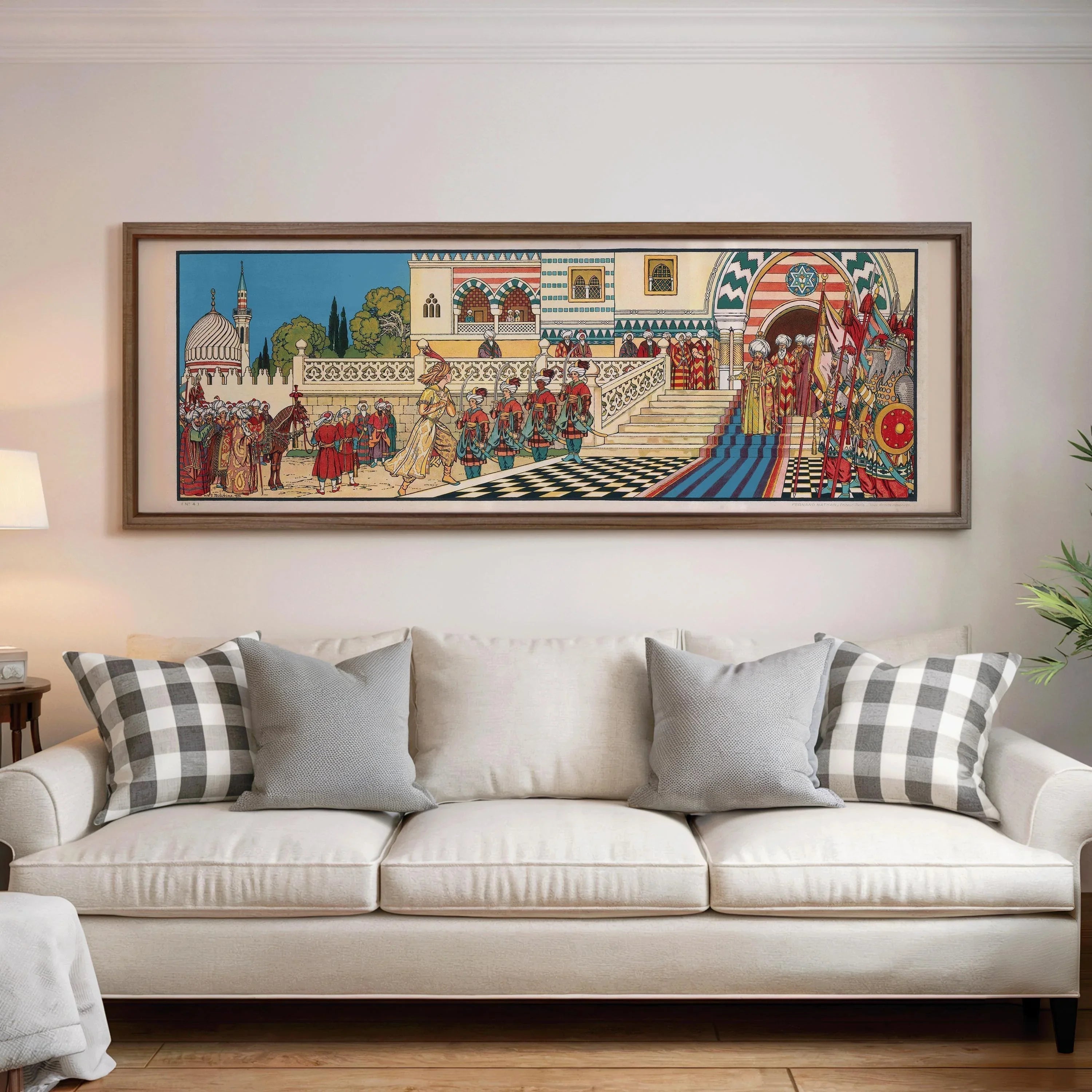
What Art Print Size Should I Buy for My Sofa, Bed, or Dining Room Wall?
This article is part of our Guide to Buying Fine Art Prints.
Most people think they have chosen the wrong artwork when the real problem is simpler: the print is too small.
That happens constantly.
A good piece of art can still look weak if it floats above a large sofa, gets lost over a bed, or feels apologetic on a dining room wall. Designers use a few simple sizing rules to avoid that. One common rule is that art hung above furniture should span roughly two-thirds to three-quarters of the furniture’s width, while another is to keep the piece several inches above the furniture rather than too high up the wall.
In brief: For most rooms, the safest starting point is art that is about 60–75% of the width of the furniture below it. Hang it low enough to feel connected—usually around 6–8 inches above the sofa, bed, or sideboard—and go bigger rather than smaller if you want the room to feel more intentional.
Start With Width, Not Height

Pictured - Waterlilies | Claude Monet
If you want a fast rule, start here: the art or arrangement above your furniture should usually be around two-thirds to three-quarters of that furniture’s width. That guideline appears across design advice because it helps the art feel visually anchored instead of disconnected.
That means:
- above a 90-inch sofa, aim for roughly 54–68 inches of total art width
- above a 60-inch bed, aim for roughly 36–45 inches
- above a 72-inch sideboard or dining room console, aim for roughly 43–54 inches
These are not rigid laws. They are starting points. But they are good ones.
How High Should the Print Hang?
Once the width is right, the next mistake is usually hanging the piece too high.
Architectural Digest notes the classic gallery guideline of hanging art so the center sits around 57 inches from the floor, while Homes & Gardens highlights a more furniture-specific rule of thumb: keep the artwork around 8 inches above the furniture below it.
For homes, the furniture rule is usually more useful than the museum rule. If the art is above a sofa, bed, or dining room sideboard, it should feel related to that furniture—not like it drifted upward on its own.
What Size Art Should I Buy for a Sofa?

Pictured - Set of 3 Hiroshi Yoshida Prints
Above a sofa, undersized art is the most common mistake.
If the sofa is large, a small framed print in the middle will almost always look timid. This is where one large statement piece often works best. If you prefer more than one piece, think of the grouping as a single visual unit and size the total width accordingly. West Elm’s gallery wall advice similarly recommends anchoring the arrangement around the largest piece and keeping a few inches between works. :contentReference[oaicite:4]{index=4}
A good sofa rule: aim for art that spans roughly 60–75% of the sofa’s width, and hang it around 6–8 inches above the back.
If your sofa is especially long, go larger than you think. In most living rooms, art that is too small looks cheaper than art that is slightly oversized.
What Size Art Should I Buy for Above a Bed?
Above a bed, the same width logic applies, but the mood is usually different.
Bedrooms often benefit from art that feels calmer and more integrated than a living-room statement piece. That means you can go broad without necessarily going loud.
A single horizontal print works well above many beds. Two related works can also work, as long as the overall arrangement still occupies a strong portion of the bed’s width. The same 60–75% range is still a useful guide.
One caution: if your headboard is tall or visually heavy, the artwork needs enough scale to hold its own. Otherwise the bed wins and the art disappears.
What Size Art Should I Buy for a Dining Room Wall?

Pictured - About the Town | Paul Klee
Dining room walls give you a little more freedom.
Because there is often more open wall space and less visual competition from soft furnishings, you can use a strong single piece, a pair, or a more formal arrangement. The same proportional logic still helps: the art should relate to the furniture beneath it if there is any, or to the wall zone it occupies if there is not.
If the art is above a buffet, console, or sideboard, use the same furniture-width rule. If it is on a larger blank wall, you can go bigger than that, especially if the room needs a focal point.
One Large Piece or Several Smaller Ones?
Both can work. The question is what job the art needs to do.
If you want the wall to feel clean, expensive, and resolved, one larger piece is often the easiest answer. If you want more rhythm or storytelling, a pair or gallery-style grouping can work well—provided it is hung as a coherent arrangement rather than scattered fragments. Design guidance on gallery walls consistently emphasizes starting with a central anchor and keeping spacing tight and intentional.
If you go with multiple pieces, treat them as one overall shape. The wall reads the whole arrangement first, not each frame individually.
The Mistakes That Make Art Look Wrong
Most sizing errors are predictable:
- the print is too narrow for the furniture below it
- the piece is hung too high
- multiple works are spaced too far apart
- the buyer chooses based only on the image, not on the wall it has to occupy
These mistakes make even good art feel disconnected. By contrast, good scale makes a room feel calmer, more intentional, and often more expensive. That is one reason designers tend to prefer fewer, better-scaled works over several small filler pieces.
The Bottom Line
If you are deciding what size art print to buy for a sofa, bed, or dining room wall, start with proportion.
For most homes, art looks right when it spans about 60–75% of the furniture below it and hangs close enough to feel connected—usually around 6–8 inches above. From there, choose whether you want one large piece or a grouping that reads as one.
And when in doubt, go a little bigger. People rarely regret art that has enough presence. They often regret art that never had enough to begin with.