What Is Shin Hanga Art?
This article is part of our Guide to Buying Fine Art Prints.
A Beginner’s Guide to Japanese Woodblock Prints for Modern Homes
Shin Hanga is one of the most quietly powerful movements in Japanese printmaking.
The images are often calm: snow falling outside a temple, rain on a bridge, a mountain at dawn, a quiet street at night. But behind that calm is a major 20th-century revival of Japanese woodblock printing — one that brought together traditional craft, modern light, Western perspective, and a new sense of atmosphere.
That is why Shin Hanga prints still feel so usable today. They are historical without feeling heavy. Decorative without feeling generic. Elegant without feeling cold.
In brief: Shin Hanga means “new prints.” It was a 20th-century Japanese woodblock print movement, strongly associated with publisher Shōzaburō Watanabe, that revived ukiyo-e printmaking with modern light, atmosphere, perspective, and production quality. Today, Shin Hanga works by artists such as Kawase Hasui and Hiroshi Yoshida remain popular because they feel calm, cinematic, and surprisingly modern in contemporary interiors.
If you are already looking for prints, start with our Shin Hanga Masters collection, including Kawase Hasui prints and Hiroshi Yoshida prints. If you would rather be shown ten specific prints and which room each one suits, read Best Japanese Woodblock Prints for Modern Homes.
What Does Shin Hanga Mean?

Pictured - Lake Matsubara | Kawase Hasui
Shin Hanga literally means “new prints.”
The term refers to a Japanese print movement that emerged in the early 20th century. The Museum of New Zealand Te Papa Tongarewa notes that Tokyo publisher Shōzaburō Watanabe coined the name around 1915. Watanabe became the movement’s central publisher and promoter, gathering artists whose designs could be translated into high-quality woodblock prints using traditional techniques.
In simple terms, Shin Hanga was a modern revival of Japanese woodblock printing.
It kept the older collaborative system of Japanese printmaking: an artist designed the image, a carver cut the blocks, a printer printed the image, and a publisher coordinated production and sales. But the look was different from earlier ukiyo-e. Shin Hanga used more modern light, softer atmosphere, more naturalistic space, and a heightened sense of mood.
The result was not a copy of Edo-period printmaking. It was a 20th-century reinvention.
How Shin Hanga Differs From Ukiyo-e

Pictured - Wakatsuru, Ukiyo-e Print | Kitagawa Utamaro
Shin Hanga grew out of the older ukiyo-e tradition, but it does not look exactly the same.
Ukiyo-e prints from the Edo period often focused on kabuki actors, courtesans, famous views, historical scenes, and the urban culture of the “floating world.” They were bold, graphic, and often highly stylized.
Shin Hanga kept many traditional subjects — landscapes, beautiful women, actors, flowers, birds, temples, bridges, and famous places — but gave them a more modern visual language.
Shin Hanga tends to emphasize:
- light and shadow
- weather and atmosphere
- rain, snow, mist, dusk, and moonlight
- quieter compositions
- more naturalistic perspective
- a sense of memory or nostalgia
- very high production quality
That is why many Shin Hanga prints feel so contemporary now. They have the restraint of traditional Japanese art, but they also feel close to photography, cinema, and modern illustration.
Why Shin Hanga Still Looks Modern

Pictured - El Capitan | Hiroshi Yoshida
Shin Hanga prints work well in modern homes because they are visually restrained.
They do not usually shout across the room. They hold the room quietly.
A Hasui snow scene, a Yoshida mountain view, or a Shinsui figure study can bring atmosphere without overwhelming the space. These works often use limited palettes, strong silhouettes, open space, and carefully balanced compositions. That makes them especially useful in contemporary interiors.
Shin Hanga works well in:
- bedrooms
- reading rooms
- home offices
- dining rooms
- hallways
- minimalist interiors
- warm neutral spaces
- rooms where you want calm rather than noise
The appeal is not only decorative. Shin Hanga prints often feel like places you can enter. That is why they still hold attention after the first glance.
Kawase Hasui: Rain, Snow, Night, and the Vanishing Landscape

Pictured - Spring Snow at Kiyomizu Temple
Kawase Hasui is one of the defining artists of Shin Hanga.
He was born in Tokyo in 1883 and became known above all for landscapes and townscapes. His life did not begin as a straight path into art. After family business difficulties, he pursued artistic training more seriously, studying Western-style painting and later entering the circle of the painter Kaburagi Kiyokata.
Hasui’s major breakthrough came through Shōzaburō Watanabe. After seeing the work of Itō Shinsui, Hasui approached Watanabe, who published his first experimental prints in 1918. Their partnership became one of the most important relationships in Shin Hanga.
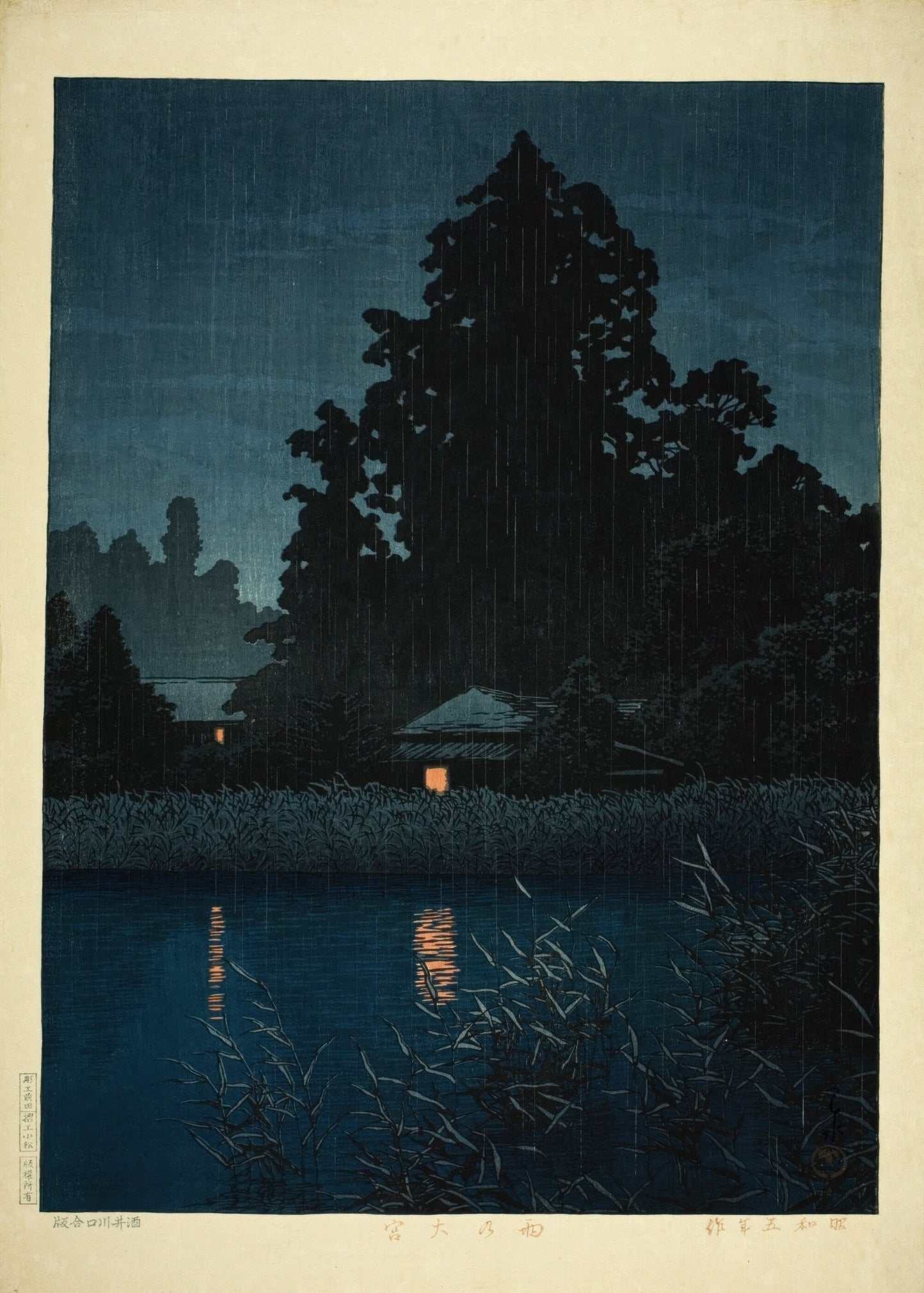
Hasui’s great subject was atmosphere.
He was especially strong at:
- snow falling at temples
- rainy streets
- moonlit water
- quiet bridges
- villages and townscapes
- landscapes that feel remembered rather than staged
His career was also marked by loss. The Great Kantō earthquake of 1923 devastated Tokyo and destroyed Watanabe’s workshop. Sources on Hasui’s life record that finished woodblocks, undistributed prints, and large numbers of Hasui’s sketchbooks were lost. Hasui continued working after the disaster, traveling and sketching across Japan. His later prints often feel even more committed to preserving a Japan that was changing quickly.
That is part of his power. Hasui’s prints often show stillness, but they are not empty. They carry the feeling of a world under pressure: modernizing, rebuilding, disappearing, and being remembered.
If you are drawn to rain, snow, twilight, temples, and quiet streets, start with our Kawase Hasui prints. There are more than two hundred of them, so if you want help narrowing the field, our guide to which Hasui belongs in your home sorts his work into four moods — rain, snow, moonlight and blue-hour water — and matches each to a room, a frame and a size.
Hiroshi Yoshida: Mountains, Travel, Light, and Control

Hiroshi Yoshida is the other great name many buyers encounter when they begin exploring Shin Hanga.
Yoshida was born in Kurume, Fukuoka Prefecture, in 1876. He was adopted by his art teacher Yoshida Kasaburō and took the Yoshida name. His early training was strongly connected to Western-style painting, and he studied in Kyoto and Tokyo before becoming known as a painter and later as a printmaker.
Yoshida’s career was shaped by travel.
He visited the United States, Europe, India, China, Korea, and many regions of Japan. He was also an enthusiastic mountaineer. That matters because his prints often feel expansive: mountains, rivers, temples, boats, palaces, gardens, and distant views.
Yoshida met Watanabe and entered printmaking around 1920, but he did not remain simply a publisher-dependent Shin Hanga artist. He later established his own workshop and maintained unusual control over production. His jizuri seal — meaning “self-printed” — is associated with works he personally supervised and is important to collectors of original lifetime impressions.
Where Hasui often feels intimate and atmospheric, Yoshida often feels luminous and panoramic.
He is especially strong for:
- mountain landscapes
- travel scenes
- temples and historic architecture
- water and boats
- views of India, Europe, and North America
- works where light changes the entire mood of the scene
Yoshida’s prints can feel more outward-looking than Hasui’s. They carry the eye across distance. That makes them especially good for rooms where you want the art to open up the wall.
If you prefer mountains, travel scenes, luminous color, and grander landscapes, explore our Hiroshi Yoshida prints.
Hasui vs Yoshida: Which Should You Choose?
Both artists belong to the Shin Hanga world, but they do different things in a room.
| Artist | Best known for | Best if you want |
|---|---|---|
| Kawase Hasui | Rain, snow, night scenes, temples, quiet streets, atmospheric landscapes | Calm, mood, silence, restraint, intimate atmosphere |
| Hiroshi Yoshida | Mountains, travel scenes, water, architecture, luminous landscapes | Light, distance, grandeur, movement, a more expansive wall presence |
Choose Hasui if you want the room to feel quieter.
Choose Yoshida if you want the room to feel more open.
Choose both if you want a pair or trio that balances atmosphere and scale.
Did Shin Hanga Influence Popular Culture?

Shin Hanga is not a pop-culture movement in the way Hokusai’s Great Wave is. There is no single Hasui or Yoshida image that has become a universal meme or logo.
Its influence is quieter.
Shin Hanga has had a long afterlife among collectors, designers, architects, and people drawn to Japanese visual restraint. The Smithsonian’s National Museum of Asian Art, for example, has written about Steve Jobs and Japanese art in the context of an exhibition on Japan’s influence on his visual world. The same piece notes a photo of a young Jobs with an early Macintosh monitor showing Hashiguchi Goyō’s Woman Combing Her Hair (Pictured), another major early 20th-century Japanese print image.
That connection is useful because it explains Shin Hanga’s modern appeal. These prints do not feel antique in the usual sense. They feel designed. They share something with the best modern objects: restraint, clarity, craft, and atmosphere.
That is one reason Shin Hanga keeps coming back into view — not as nostalgia alone, but as a visual language that still feels current.
Why Shin Hanga Works So Well as Wall Art

Pictured - Passing Rain | Ito Shinsui
Shin Hanga prints are unusually good as wall art because they combine clarity and atmosphere.
They are specific enough to reward looking. But they are calm enough to live with.
That makes them especially strong when you want art that feels sophisticated without becoming loud.
They work well because:
- the compositions are usually clear and balanced
- the palettes are often restrained
- weather and light create mood without visual clutter
- the subjects feel rooted in place
- the style bridges traditional and modern interiors
- the prints often look excellent in simple wood, black, or warm-toned frames
For a modern home, Shin Hanga can be a better choice than a very famous European painting reproduction if you want something refined but less expected.
It is recognizable to people who know art, but not overexposed in the way Van Gogh, Monet, or Klimt often are.
What to Look for When Buying Shin Hanga Prints

Pictured - Fisherman | Kanae Yamamoto
If you are buying an original Shin Hanga woodblock print, condition, edition, publisher seals, margins, signatures, and provenance all matter. Original lifetime impressions by major artists can be valuable, and serious collectors often look closely at publisher seals, printing quality, paper condition, and whether a work was produced during the artist’s lifetime.
If you are buying a modern reproduction, the questions are different.
Look for:
- source image quality — the scan or file needs to be strong enough for the print size
- paper quality — Shin Hanga usually benefits from a serious matte or textured fine art paper
- print process — archival giclée is usually better for subtle color and tonal transitions
- size and ratio — many Japanese prints have proportions that should not be carelessly cropped
- framing — simple frames often work best
- seller transparency — the shop should name the paper and explain the print process
At 9 Art Prints, our Shin Hanga reproductions are produced as archival giclée prints on fine art paper, with framed and unframed options. For many core prints, we use Hahnemühle German Etching 310 gsm because these works benefit from a paper that feels substantial without distracting from the image.
For more on the material side, read What Paper Is Best for Art Prints? and Giclée vs Digital Print: What’s the Real Difference?.
How to Frame Shin Hanga Prints
Shin Hanga prints usually do not need elaborate framing.
In most homes, they look best when the frame supports the image rather than competing with it.
Good choices include:
- black frames for a graphic, modern look
- natural wood frames for warmth and softness
- walnut or brown frames for a slightly more traditional feel
- white frames for light, contemporary spaces
- wide mats if you want a quieter, gallery-like presentation
Be careful with overly ornate frames. They can work in some traditional interiors, but they may overpower the quietness of a Hasui night scene or a Yoshida landscape.
Glazing also matters. Shin Hanga prints often rely on subtle color and atmosphere, so glare can weaken the effect. Low-reflection glazing is useful if the work will hang near windows, lamps, or bright rooms.
For the practical details, read How to Frame Art Prints in 4 Easy Steps and Buy Art Prints Like a Pro: 5 Terms You Should Know.
Where to Start
If you are new to Shin Hanga, start with the mood you want.
- For rain, snow, silence, temples, and twilight, start with Kawase Hasui — and read which Hasui belongs in your home.
- For mountains, travel, water, architecture, and expansive landscapes, start with Hiroshi Yoshida.
- For a wider range of artists, browse our Shin Hanga Masters collection.
- For ten specific prints chosen by room, read Best Japanese Woodblock Prints for Modern Homes.
- For related works across East Asian art, explore our Japanese & Asian Art collection.
You do not need to know the whole history before buying your first Shin Hanga print.
You only need to notice what kind of stillness you prefer.
The Bottom Line
Shin Hanga matters because it made Japanese woodblock printing feel new again.
It preserved the craft of the old printmaking system while introducing modern atmosphere, light, perspective, and emotional restraint. Kawase Hasui gave the movement some of its quietest and most memorable images of rain, snow, temples, and streets. Hiroshi Yoshida expanded its range through travel, mountains, international scenes, and a remarkable control of light.
That is why Shin Hanga still works on the wall.
It does not just decorate a room.
It changes the room’s atmosphere.
Further Reading
- The Ultimate Guide to Fine Art Prints
- Kawase Hasui Prints: Which Hasui Belongs in Your Home
- Best Japanese Woodblock Prints for Modern Homes
- What Paper Is Best for Art Prints?
- Giclée vs Digital Print: What’s the Real Difference?
- What Does Archival Mean in Art Prints?
- Buy Art Prints Like a Pro: 5 Terms You Should Know
- How to Frame Art Prints in 4 Easy Steps
References
- Museum of New Zealand Te Papa Tongarewa — Shin-hanga: Japan’s “New Print” Movement
- Te Papa Collections Online — Shin Hanga category
- Art & History Museum Brussels — Shin hanga: The New Prints of Japan 1900–1960
- The Lavenberg Collection of Japanese Prints — Kawase Hasui
- The Lavenberg Collection of Japanese Prints — Hiroshi Yoshida
- Artelino — Hiroshi Yoshida biography and collector guide
- Smithsonian National Museum of Asian Art — Japan: The Apple of Steve Jobs’ Eye?