Artist · 3 prints
Chamba school Prints
About the Chamba School
Chamba painting is the Pahari miniature painting of Chamba, a hill kingdom in present-day Himachal Pradesh. Like other hill schools, it took up the legends of Krishna, Hindu myths and portraits of rulers. A leading figure of the mid-18th century was the painter Laharu, of the Manikanth family of Gujarati origin, whose members had worked in a Mughal workshop in Lahore before settling in Chamba.
Laharu worked in the reign of Raja Umed Singh (1748–64). In 1758 a set of Bhagavata Purana paintings, following Krishna's life from his birth to his early victories over demons, was made for Umed Singh's younger brother and chief minister, Mian Samsher Singh. Laharu used flat backdrops and an Indian way of showing space, drawing buildings at an angle rather than letting them shrink into the distance. Murals in the Devi Kothi temple in Chamba show related scenes, and his descendants still work as painters in Chamba.
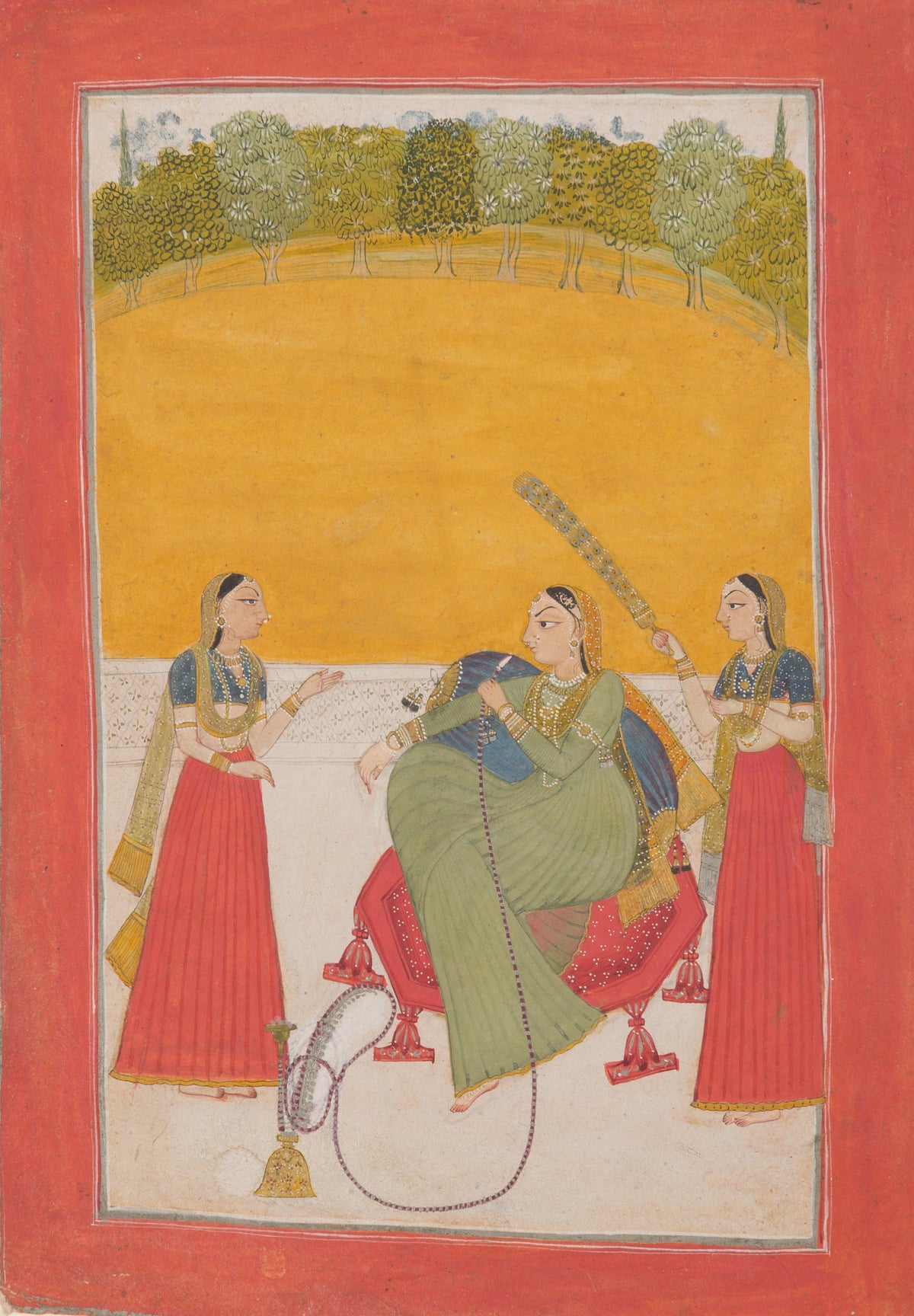
Chamba school prints: reproductions of miniature paintings from the hill kingdom of Chamba, made from around 1700 to 1765. The collection includes Vishnu on Ananta, the Endless Serpent (1700), Rama and Lakshmana Fighting Ravana (1765) and Lady on a Terrace.
This selection brings together the god Vishnu resting on the cosmic serpent, a battle from the Ramayana, and a court lady on a terrace. The two dated pages come from about 1700 and 1765, so the group shows Chamba painting across much of the 18th century.
The Vishnu and Ramayana scenes suit living rooms and studies, and the lady on a terrace works in a bedroom or hallway. All prints are museum-quality reproductions, available unframed or framed with acrylic glazing, with free shipping and import duties covered.