Artist · 10 prints
Henry Farny Prints
About Henry Farny
Henry Farny was a French-born American painter and illustrator, born in Ribeauvillé, Alsace, on 15 July 1847 and died in Cincinnati, Ohio, on 23 December 1916. His family emigrated to the United States when he was a boy and settled first in Warren, Pennsylvania, near a Seneca reservation, before moving to Cincinnati around 1859. He began as a magazine illustrator, and took lessons in Düsseldorf from Albert Bierstadt in the late 1860s.
In 1881 Farny travelled up the Missouri River to Fort Yates in Dakota Territory, sketching and photographing the Sioux and collecting objects. That trip turned him toward Native American subjects, which he painted for the rest of his life, working from his studio in Cincinnati. The Captive (1885) is in the Cincinnati Art Museum, and The Song of the Talking Wire (1904), a Sioux man listening to a telegraph pole in the snow, is at the Taft Museum of Art. Henry Farny's Danger (1888) won a bronze medal at the 1889 Paris Exposition.
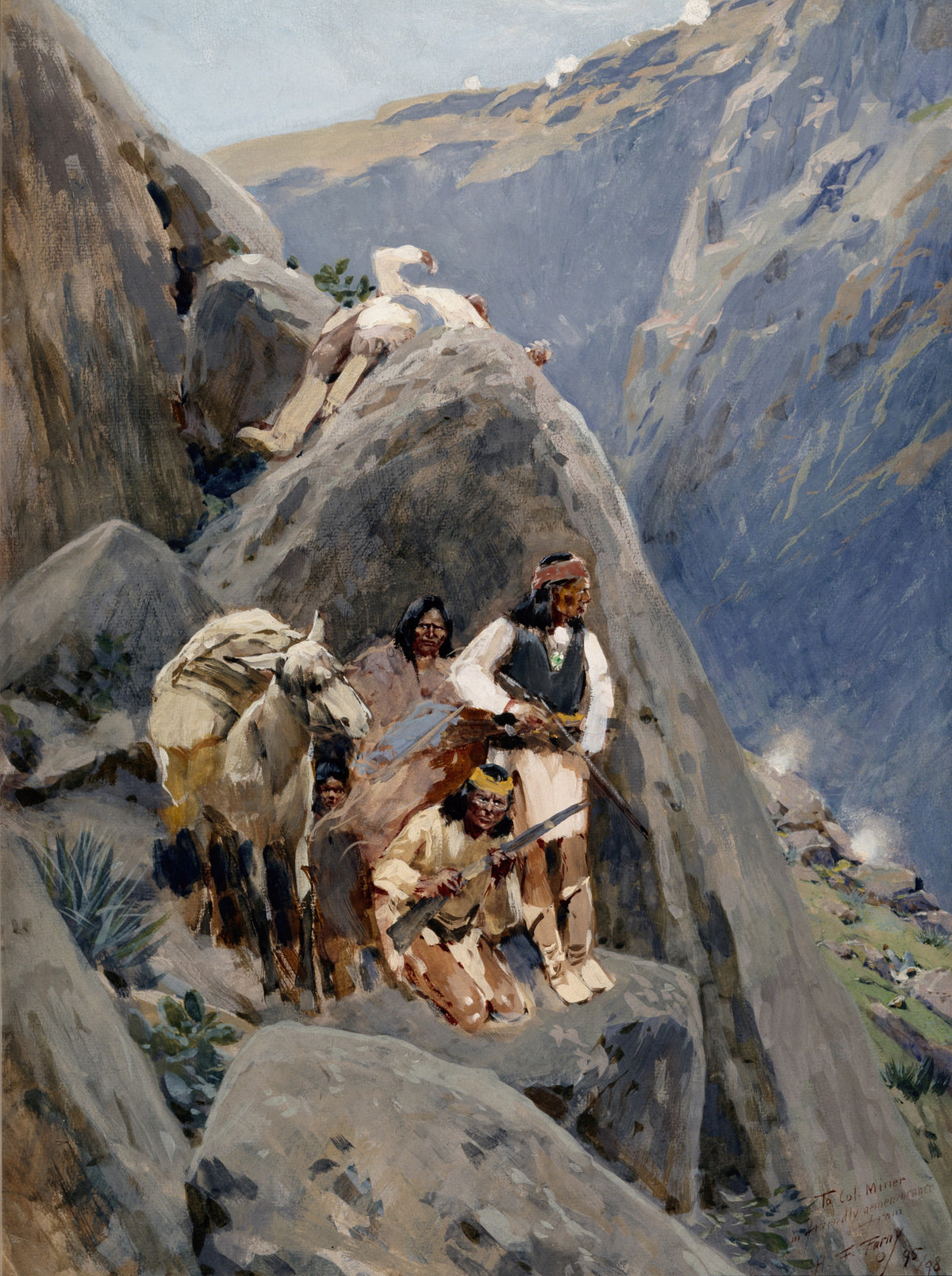
Henry Farny prints: reproductions of the Western paintings Henry Farny made between 1895 and 1911. The collection includes Saddling Up (1895), A Successful Hunt (1906), The Indian Bear Hunter (1911), The Ambush (1897) and The Day Is Done (1911).
This selection focuses on Native American hunters, riders and camps on the plains and in the mountains, including Apache Indians in the Mountains and A Moment of Suspense. Many scenes are small and quiet, with figures set in wide, open landscapes under pale skies. It also includes a sporting scene, Sage-Cock Shooting in Montana, and an oil sketch for his painting In the Shadow.
The muted browns, golds and pale skies suit studies, offices, dens and hallways, and the smaller works hang well in pairs. All prints are museum-quality reproductions, available unframed or framed with acrylic glazing, with free shipping and import duties covered.