Artist · 5 prints
Hugo Simberg Prints
About Hugo Simberg
Hugo Simberg (1873–1917) was a Finnish painter and printmaker, born in Hamina on Finland's south coast and died in Ähtäri. He studied at drawing schools in Viipuri and Helsinki, then from 1895 became a private pupil of Akseli Gallen-Kallela at his studio in the Finnish countryside. Simberg is one of the central figures of Finnish Symbolism, art that uses dreamlike images to suggest feelings and ideas rather than describe the everyday world.
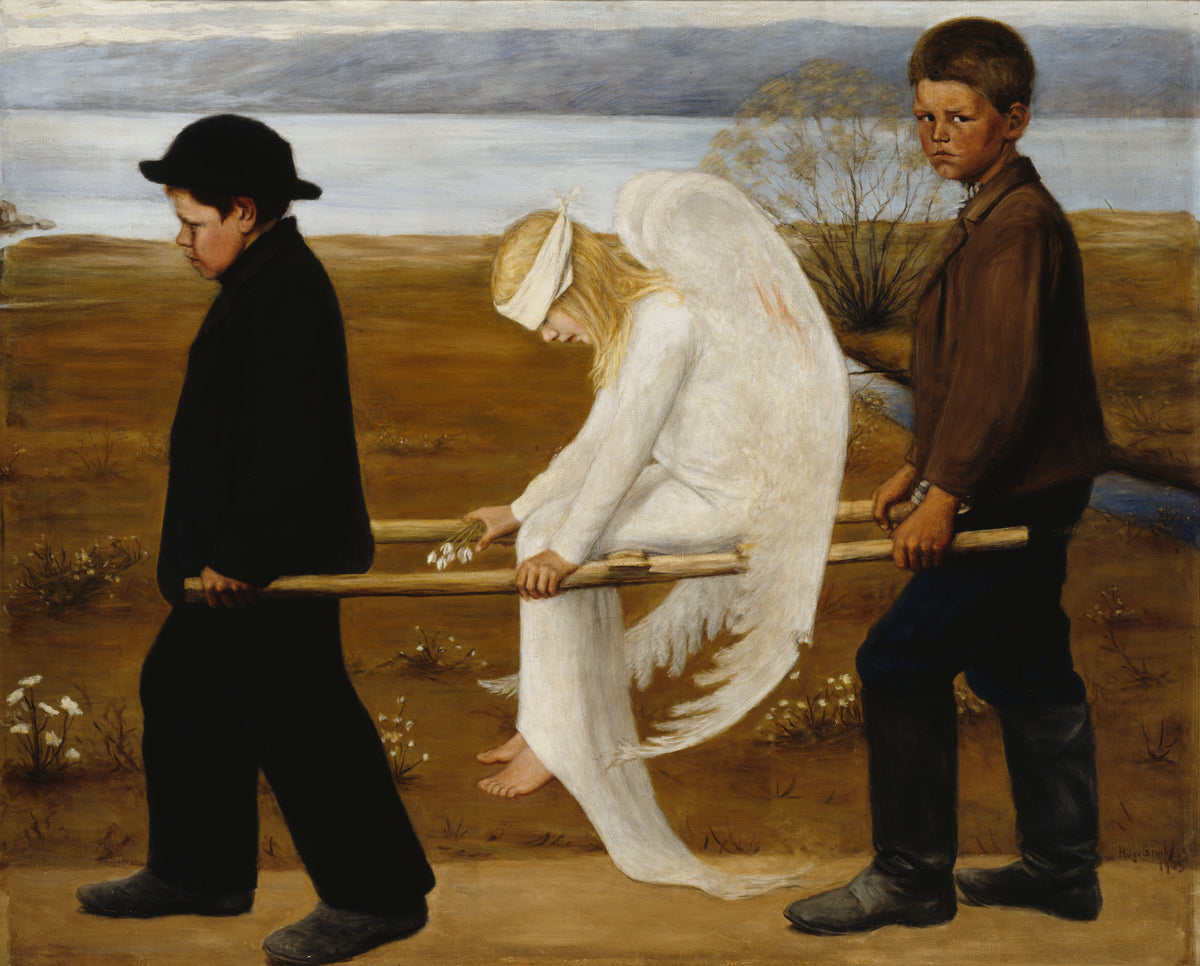
Hugo Simberg's pictures are quiet and melancholy, often peopled by figures of Death and angels. The Garden of Death (1896) is one of his best-known images. The Wounded Angel (1903), now at the Ateneum in Helsinki, shows two boys carrying an angel with a bandaged head through a Helsinki park; in 2006 it was voted Finland's national painting. Simberg would not explain its meaning, leaving it to viewers. With Magnus Enckell he also painted the interior of Tampere Cathedral between 1904 and 1906.
Hugo Simberg prints: reproductions of paintings and watercolours by the Finnish Symbolist Hugo Simberg, made between 1895 and 1903. The collection includes The Wounded Angel (1903), Death Listens (1897), Frost (1895), King Hobgoblin Sleeping (1896) and Hulluus (1895).
This selection shows both sides of his work: melancholy scenes such as the bandaged angel carried by two boys and Death listening to a young violinist, and folk-tale figures such as a frost spirit and a sleeping hobgoblin. The colours are muted, with earthy greens, browns and greys, and the scenes are simple, with few figures.
The muted palettes suit bedrooms, studies and reading corners, and the smaller folk-tale works suit hallways and quiet nooks. All prints are museum-quality reproductions, available unframed or framed with acrylic glazing, with free shipping and import duties covered.