Artist · 15 prints
Otto Eckmann Prints
About Otto Eckmann
Otto Eckmann was a German painter and designer, born on 19 November 1865 in Hamburg, and he died in Badenweiler in 1902. He trained at the schools of applied arts in Hamburg and Nuremberg and then at the Munich Academy. He exhibited paintings in Munich from 1890, but in 1894 he auctioned his paintings and turned to applied art. In 1897 he began teaching ornamental painting at the school of the Royal Museum of Applied Arts in Berlin.
Otto Eckmann became one of the leading designers of German Jugendstil, the German form of Art Nouveau. His drawings appeared in the art magazine Pan from 1895 and in the Munich weekly Jugend from 1896, which made his work widely known. He designed book covers, wallpapers, tapestries, ceramics and furniture, and in 1900 he created the Eckmann typeface, a decorative lettering cast by the Rudhardt type foundry. With Henry van de Velde he is credited as a founder of modern commercial graphic design.
Otto Eckmann prints: reproductions of the Jugendstil graphic designs, posters and decorative prints Otto Eckmann produced in Germany between 1895 and 1900. Works include Schwertlilien (1895), Nachtreiher (Drei Philosophen) (1896), Drei Schwäne auf dunklem Gewässer, Kunstgewerbeblatt, Neue Folge, März 1899 (1899) and AEG Weltausstellung Paris 1900 (1900).
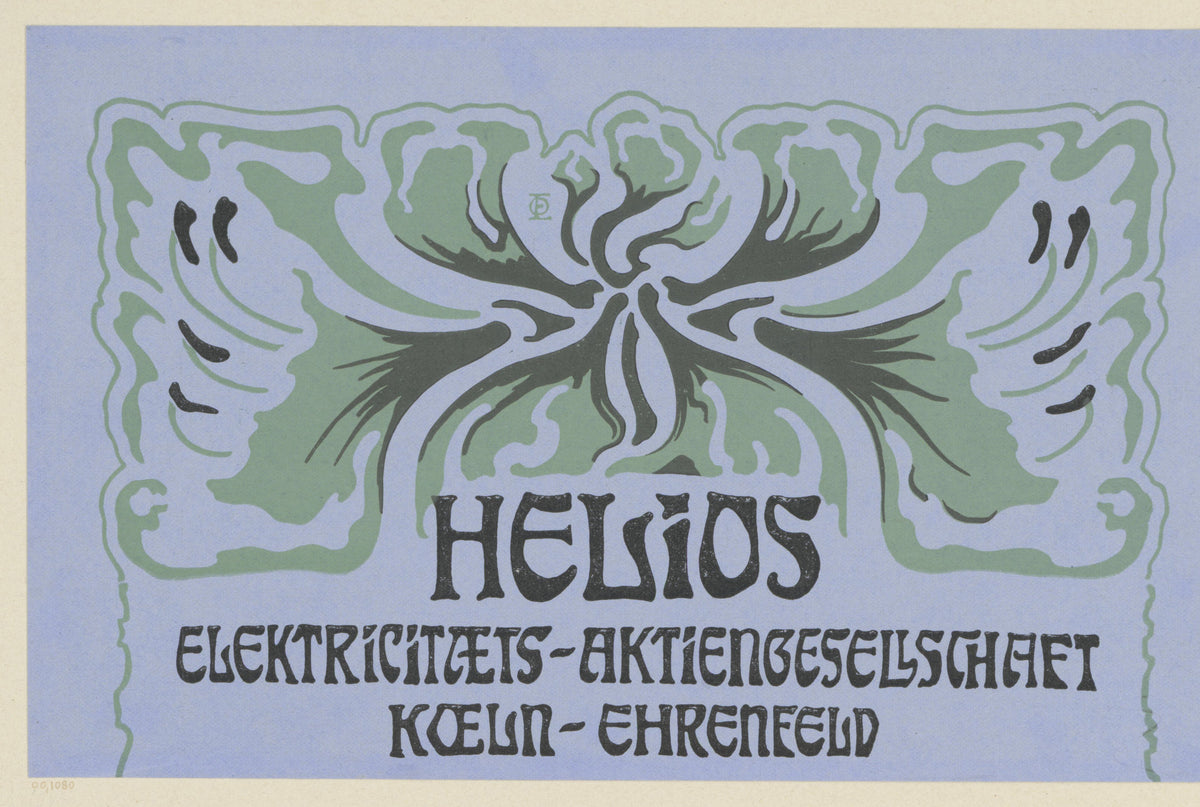
This selection shows both sides of Eckmann's work. One is nature studies of irises, herons and swans on dark water, drawn with flowing outlines. The other is commercial design: exhibition posters, magazine and catalogue covers, a company title page, a packaging label and a sheet of marbled paper, many using his lettering.
The swan and iris designs suit living rooms, bedrooms and bathrooms, and the poster and lettering pieces work well in offices, studios and kitchens. All prints are museum-quality reproductions, available unframed or framed with acrylic glazing, with free shipping and import duties covered.