Artist · 3 prints
Shen Zhou Prints
About Shen Zhou
Shen Zhou was a Chinese painter, poet and calligrapher of the Ming dynasty, born in 1427 in Xiangcheng, near Suzhou in Jiangsu province, and died in 1509. He came from a prosperous, cultured family and never took government office. After his father died he gave up the official examinations to care for his widowed mother, an act admired as filial devotion, and spent his long life on poetry, painting and calligraphy.
Shen Zhou is regarded as the founder of the Wu School, named after the Wu district around Suzhou, a circle of scholar-artists who painted for self-expression rather than as professionals. He is counted among the Four Masters of the Ming dynasty, and Wen Zhengming was his pupil. He painted mostly landscapes, drawing on earlier masters, as well as flowers in the soft "boneless" manner, without outlines. His Lofty Mount Lu, a tall hanging scroll, and Rainy Thoughts (1487) are both in the National Palace Museum in Taipei. Shen Zhou is still revered in the Chinese literati tradition.
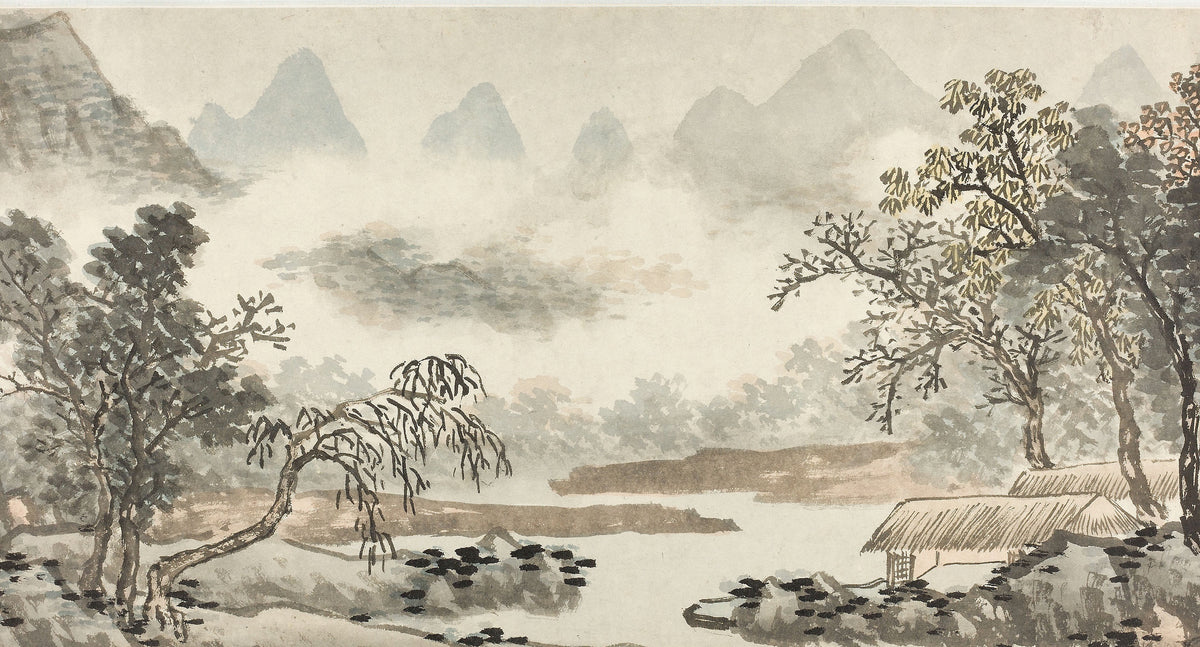
Shen Zhou prints: reproductions of Chinese ink landscape paintings by the Ming dynasty painter Shen Zhou, made between about 1490 and 1504. The collection includes two leaves from Twelve Views of Tiger Hill (around 1490), The Thousand Acres of Clouds and The Thousand Buddha Hall and the Pagoda of the "Cloudy Cliff" Monastery, and a detail from Clouds over the River before Rain (1504).
This selection focuses on the landscape around Suzhou, his home city. The Tiger Hill leaves show the hill's temple, pagoda and rock terraces with small visiting figures, in ink and light colour. Clouds over the River before Rain shows misty water and low hills in soft grey washes.
The soft greys and pale colour suit studies, offices, bedrooms and quiet reading corners, and the two Tiger Hill leaves hang well as a pair. All prints are museum-quality reproductions, available unframed or framed with low-glare acrylic glazing, with free shipping and import duties covered.