Artist · 3 prints
Ignaty Nivinsky Prints
About Ignaty Nivinsky
Ignaty Nivinsky (1880 or 1881–1933) was a Russian painter, architect, stage designer and printmaker who was born and died in Moscow. He trained at the Stroganov School in Moscow, graduating around 1898, and began as a decorative and mural painter. He took up etching around 1912, the technique of drawing into a wax-coated metal plate that is then bitten with acid and printed. He went on to help found a Moscow union of etchers and later taught at VKhUTEMAS, the Soviet art and design school, where Aleksandr Deineka was among his students.
Ignaty Nivinsky made his name as an etcher with landscapes from two trips to Crimea in 1916 and 1917, including his Gurzuf series, which moved from buildings toward figures and open scenery. His prints show the influence of Piranesi, the Italian master of dramatic architectural etchings. He was also a gifted theatre designer, creating the sets for Yevgeny Vakhtangov's famous 1922 production of Princess Turandot. Many of his theatre designs are held today at the Bakhrushin Theatre Museum in Moscow.
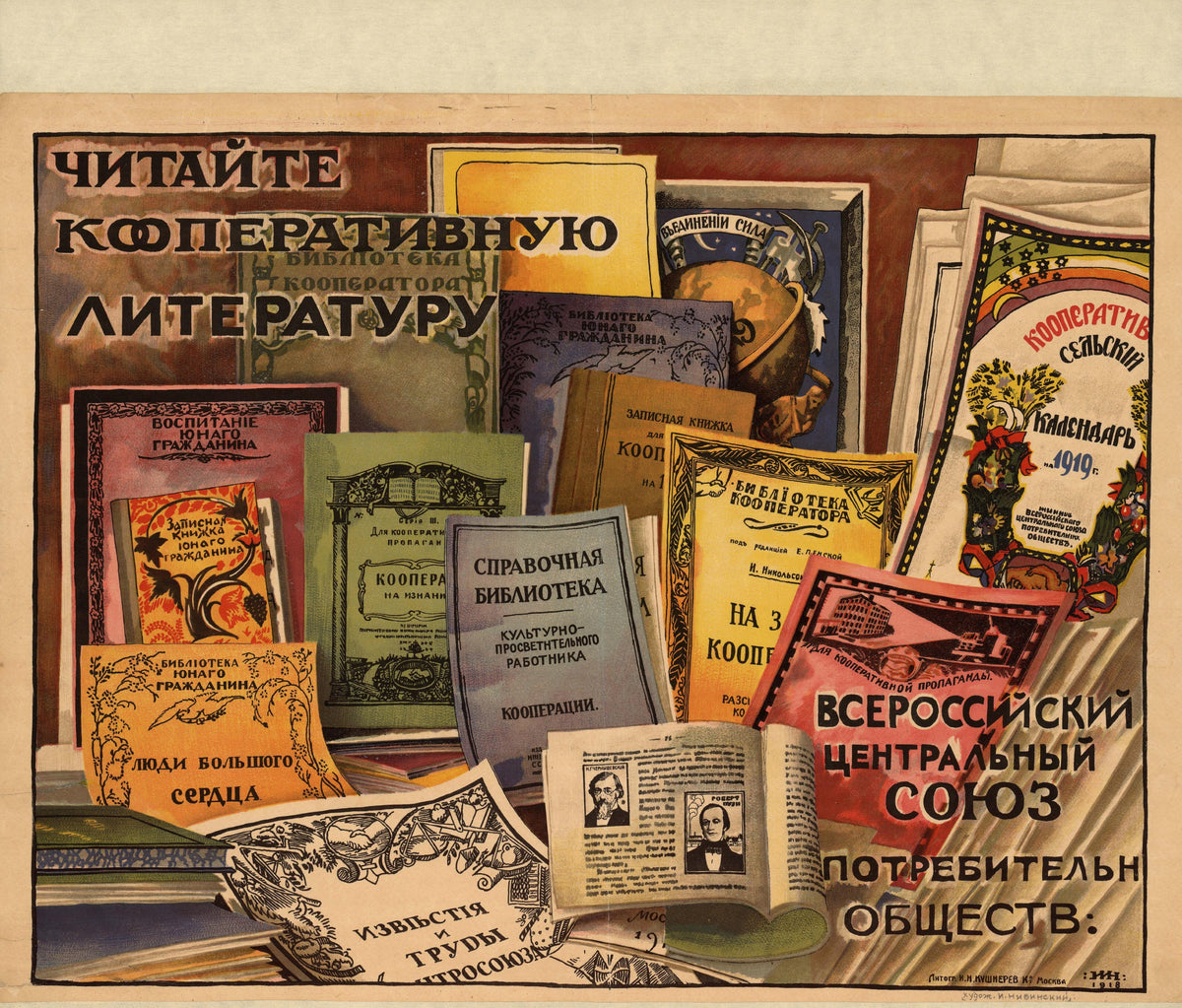
Ignaty Nivinsky prints: reproductions of the Russian and early Soviet posters Ignaty Nivinsky designed in Moscow between 1915 and 1918. The collection includes Exhibition of Easter eggs made by artists, actors, writers and public figures (1915), Read Cooperative Literature (1918) and Women, Join the Cooperative (1918).
This selection focuses on his poster work from the years around the 1917 Revolution, moving from the announcement of a charity exhibition to posters promoting the cooperative movement. The posters combine Russian lettering with drawn figures, and they show how a trained decorative painter and etcher approached public notices in those years.
Their nostalgic, period character suits a study, library or reading corner, and the posters work well as a small group on one wall. All prints are museum-quality reproductions, available unframed or framed with acrylic glazing, with free shipping and import duties covered.