Artist · 5 prints
Samuel Jessurun de Mesquita Prints
About Samuel Jessurun de Mesquita
Samuel Jessurun de Mesquita was a Dutch printmaker, draughtsman and designer, born in Amsterdam on 6 June 1868. Turned down by the Rijksakademie at 14, he trained with an architect and then qualified as a drawing teacher in 1889. From 1902 to 1926 he taught at the School for Architecture and Decorative Arts in Haarlem, where the young M. C. Escher became his pupil, and he later taught at the Rijksakademie in Amsterdam.
De Mesquita is best known for bold woodcuts and wood engravings, alongside etching and lithography. His subjects range from portraits and self-portraits to plants, flowers and animals, many drawn at Artis, the Amsterdam zoo, and strange imaginative figures, as in the woodcut Ecstasy (1922). In early 1944 the Nazis arrested him with his wife Elisabeth and their son Jaap. He and his wife were murdered at Auschwitz shortly afterwards, and Jaap died at Theresienstadt. Escher rescued prints from the empty house and in 1946 organised a memorial exhibition at the Stedelijk Museum.
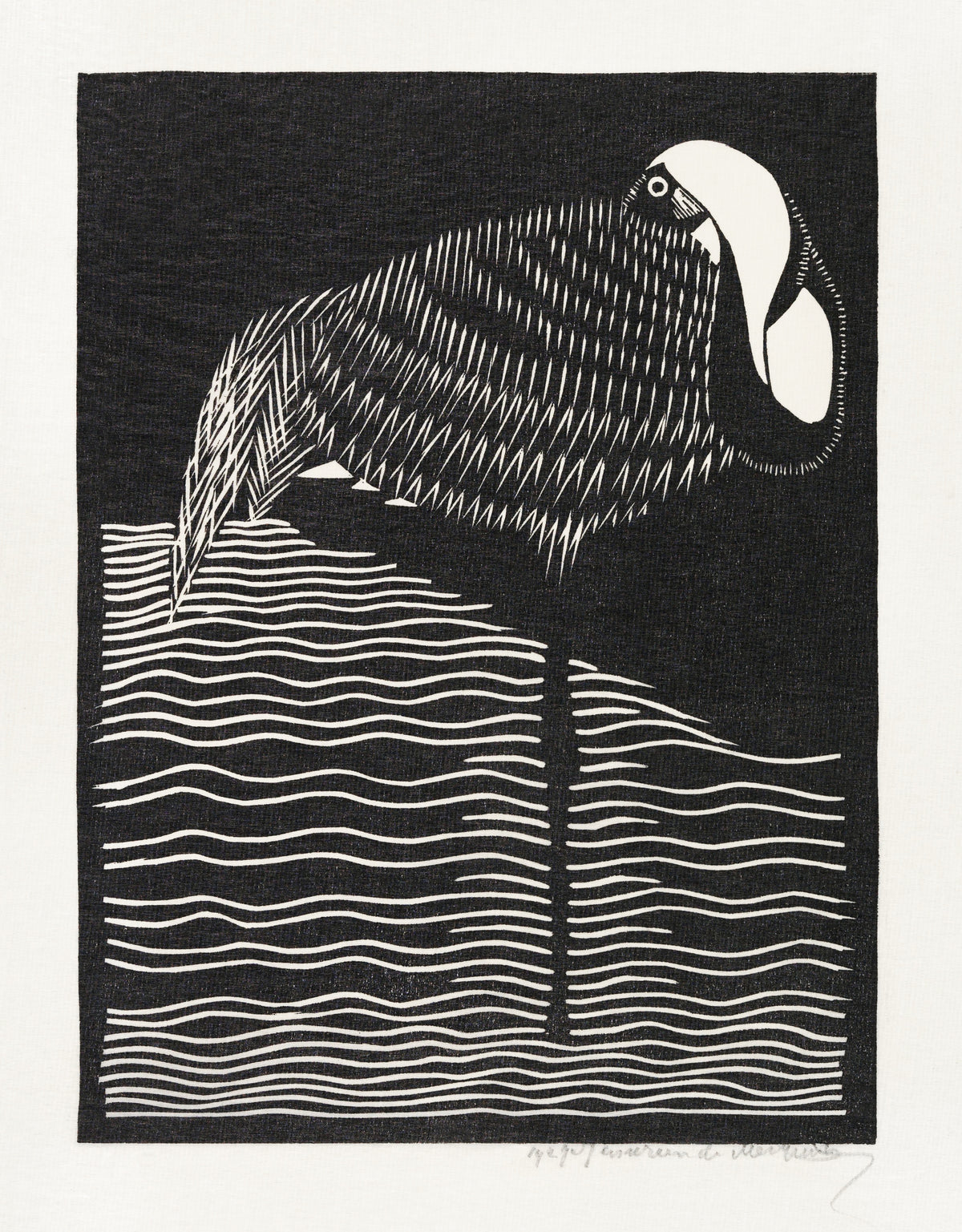
Samuel Jessurun de Mesquita prints: reproductions of woodcuts by the Dutch printmaker Samuel Jessurun de Mesquita, made between 1915 and 1929. The collection includes Hoornuil (Long-eared Owl, 1915), White-necked Crane (1927), Bloeiende cactus (Flowering Cactus, 1929) and Ara (Macaw).
This small selection concentrates on De Mesquita's studies of birds and plants. Each print isolates a single subject and builds it from cut lines and solid areas of black, with patterned feathers and leaves set against plain ground. The owl and macaw face the viewer directly, while the crane and cactus are shown in profile with strong, upright shapes.
The bold black-and-white woodcuts suit studies, libraries, hallways and modern living rooms, and they hang well as a matched pair or a set of four. All prints are museum-quality reproductions, available unframed or framed with acrylic glazing, with free shipping and import duties covered.