




A black tangle of girders, wheels and toothed rails
László Moholy-Nagy — Fametszet | Fine Art Print
Note: Framed prints require slightly longer production time
Why this print is worth it
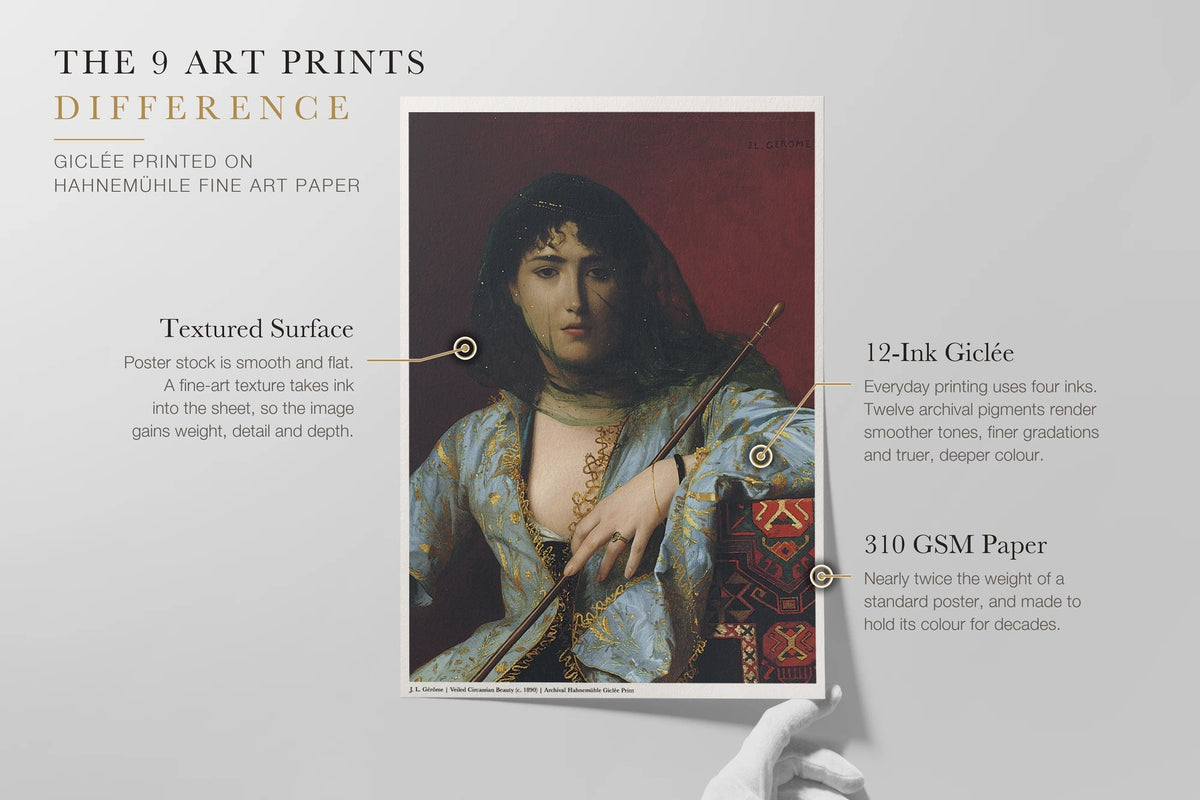
Archival giclée on Hahnemühle fine-art paper


Made as fine art, not as a mass-market poster.
We reproduce each work from high-quality source material using a 12-ink archival giclée process on Hahnemühle fine-art paper, chosen to preserve the colour, detail and character of the original as faithfully as possible.
“The quality of color and paper is museum quality and well worth the purchase price.”
Free worldwide shipping
And we cover import duties.
Wherever you are, shipping is free.
We ship worldwide at no additional shipping cost to you. If import duties are imposed on your order, we pay them too.
No shipping surcharge. No import-duty surprise.
Made to order. Protected if anything goes wrong.
If your artwork arrives damaged, defective, or incorrect, we'll replace it at no cost to you.
Heavy black bars cut across one another at every angle, building a dense machine-like tangle on cream paper. Several carry a sawtooth band down their length like a toothed rail, and a large triangle of thick beams anchors the centre. Spoked wheels sit at the lower left and lower right, fans of radiating lines open at the left and upper left, and small ladder and grid panels are wedged among the struts. The cutting is blunt and vigorous, the whites left as sharp splinters between the blacks.
László Moholy-Nagy (1895–1946) was a Hungarian painter, photographer and designer and one of the defining teachers of the Bauhaus, where he led the preliminary course and the metal workshop from 1923 to 1928. He worked in paint, photography, typography and light, pioneering the cameraless photogram and setting out his ideas in Malerei, Fotografie, Film (1925). Driven out of Germany, he worked in Amsterdam and London before settling in Chicago, where he founded the New Bauhaus in 1937. His work is held by the Museum of Modern Art, the Guggenheim, the Art Institute of Chicago and Tate.
Printed as a museum-grade giclée on Hahnemühle fine art paper using 12-ink archival pigment printing. Available handframed in FSC-certified wood with optional float glass, or unframed. Ships worldwide with free delivery to 30+ countries.
Choose options
NO VAGUE “MUSEUM QUALITY” CLAIMS. JUST THE SPECIFICATIONS.
FAQ
Fine-art quality should be something you can verify. Here is exactly what goes into a 9 Art Prints reproduction.
What makes a 9 Art Prints reproduction different?
A lot of art-print sellers describe their work as “museum quality” without telling you what that actually means. We prefer specifications. Our fine-art reproductions are produced using professional giclée printing on genuine Hahnemühle fine-art papers, selected to suit the artwork. We work from high-resolution source material and prepare each image specifically for print, with close attention to colour, detail and tonal range.
What paper do you use?
Our principal fine-art papers include Hahnemühle German Etching 310gsm and Hahnemühle Photo Rag 308gsm. German Etching has a substantial, lightly textured surface that works exceptionally well for paintings and richly coloured works. Photo Rag has a smoother cotton surface suited to graphic, modernist and highly detailed imagery.
Paper is selected according to the character of the artwork rather than using one generic stock for everything.
What does “giclée” actually mean?
Giclée is a professional fine-art printing process using archival pigment inks and high-resolution inkjet technology. Unlike inexpensive poster printing, it is designed to reproduce subtle colour gradations, fine detail and tonal depth.
It is a reproduction method widely used by artists, photographers, galleries and professional fine-art printers.
So is this really “museum quality”?
We would rather tell you what we use and let you decide. Genuine Hahnemühle fine-art paper, professional giclée printing, archival pigment inks and carefully prepared high-resolution artwork are measurable things.
“Museum quality” by itself is not.
Will large prints still look sharp?
Large-format reproduction depends heavily on the quality of the underlying artwork file. We source the highest-resolution material available and prepare each image for print rather than simply enlarging a small internet image.
That is especially important with historic paintings, posters and archival works where source quality varies considerably.
Are these just posters?
No. A poster can be printed cheaply on lightweight commercial paper. Our fine-art editions are intended as permanent pieces of wall art, produced on heavyweight fine-art substrates with professional printing methods.
For graphic or poster artwork, the image may be a historic poster; the object you receive is still a fine-art reproduction.
What about your framed prints?
Our framed pieces use solid-wood frames and are produced as finished pieces of wall art rather than inexpensive poster frames. Depending on the configuration, we also offer matting and premium glazing options.
The goal is the same as with the print itself: use materials appropriate for a piece you intend to keep.
Will the colours look exactly like my screen?
Screens emit light; paper reflects it, so no physical print can be identical to every monitor or phone display. We prepare our artwork specifically for print and aim for accurate colour, contrast and tonal reproduction.
The texture and surface of fine-art paper also give the finished piece a physical depth that cannot be shown completely on a screen.
Collector Proof
“The print is so exquisite that I literally gasped upon opening it!”
— Verified BuyerQuality Verified
A Top Quality Store on Google
Google has awarded 9 Art Prints its Top Quality Store distinction for delivering a strong shopping experience across shipping, returns, browsing, and checkout.
Shipping experience
Returns experience
Browsing experience
Checkout experience
Store quality


Still have questions? Read our FAQ