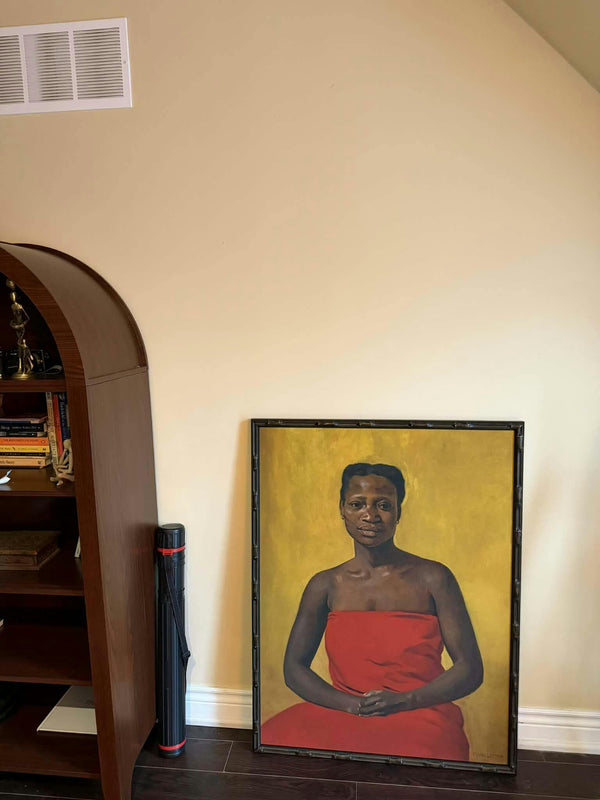
AMAZING Print and wonderful customer service. The quality is unmatched, I'm so happy
Joy T.
Félix Vallotton — Woman in Red
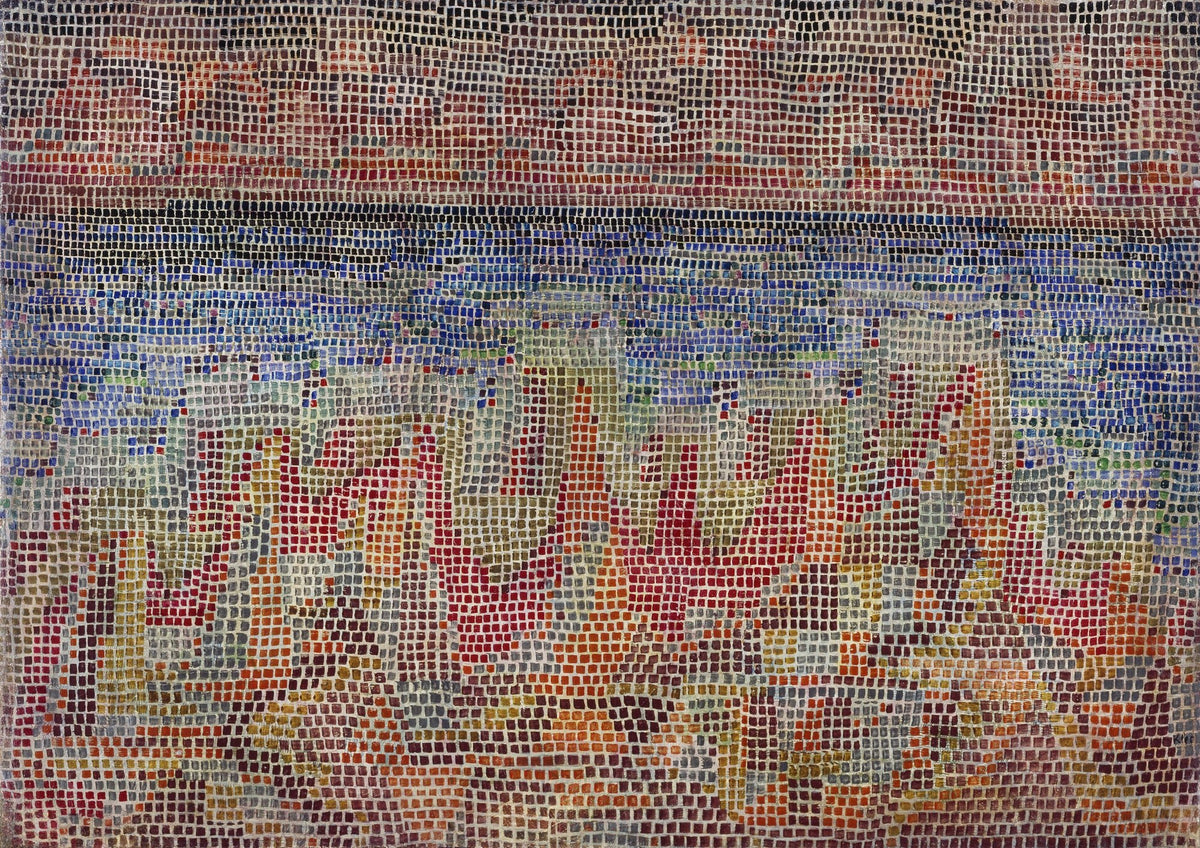
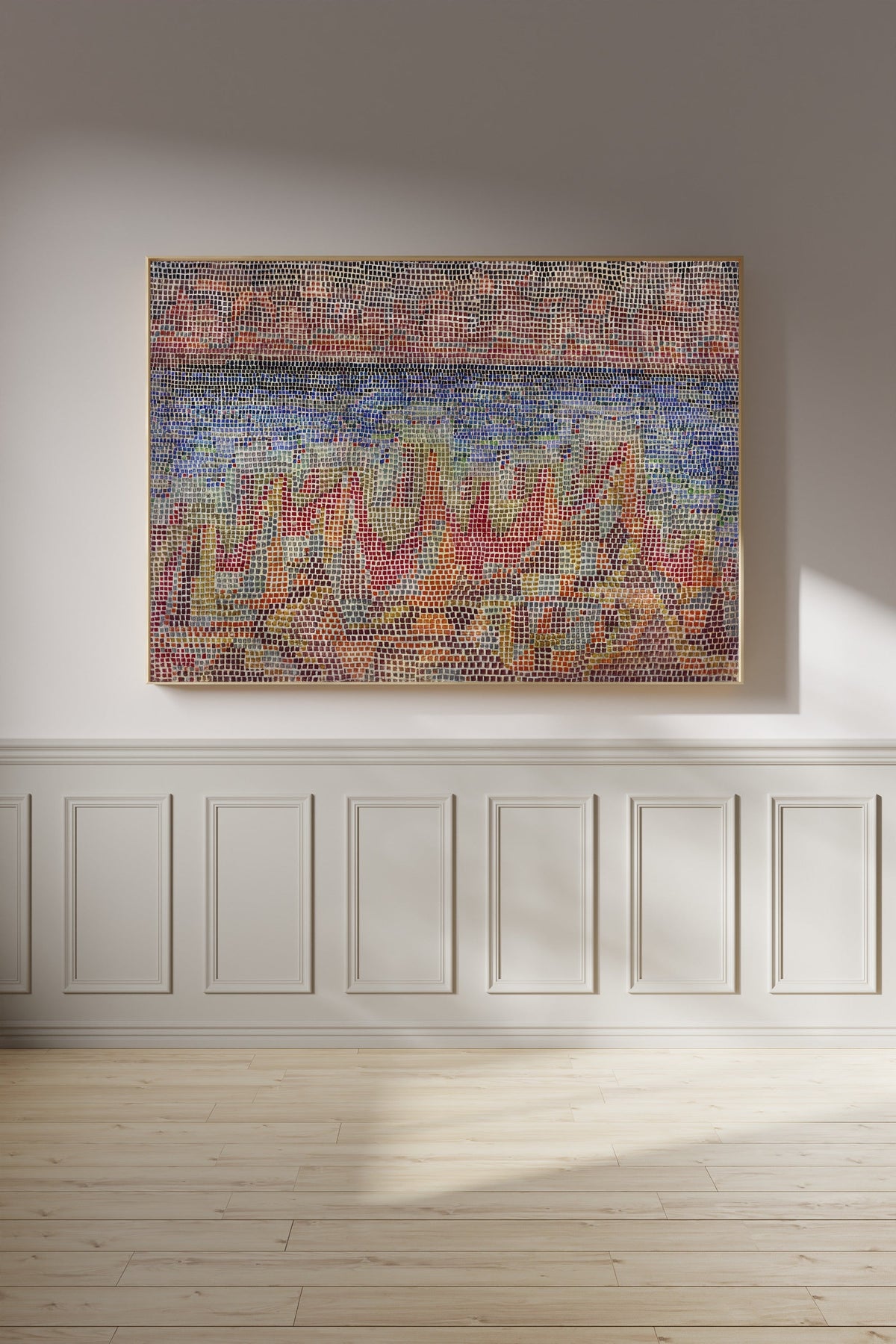

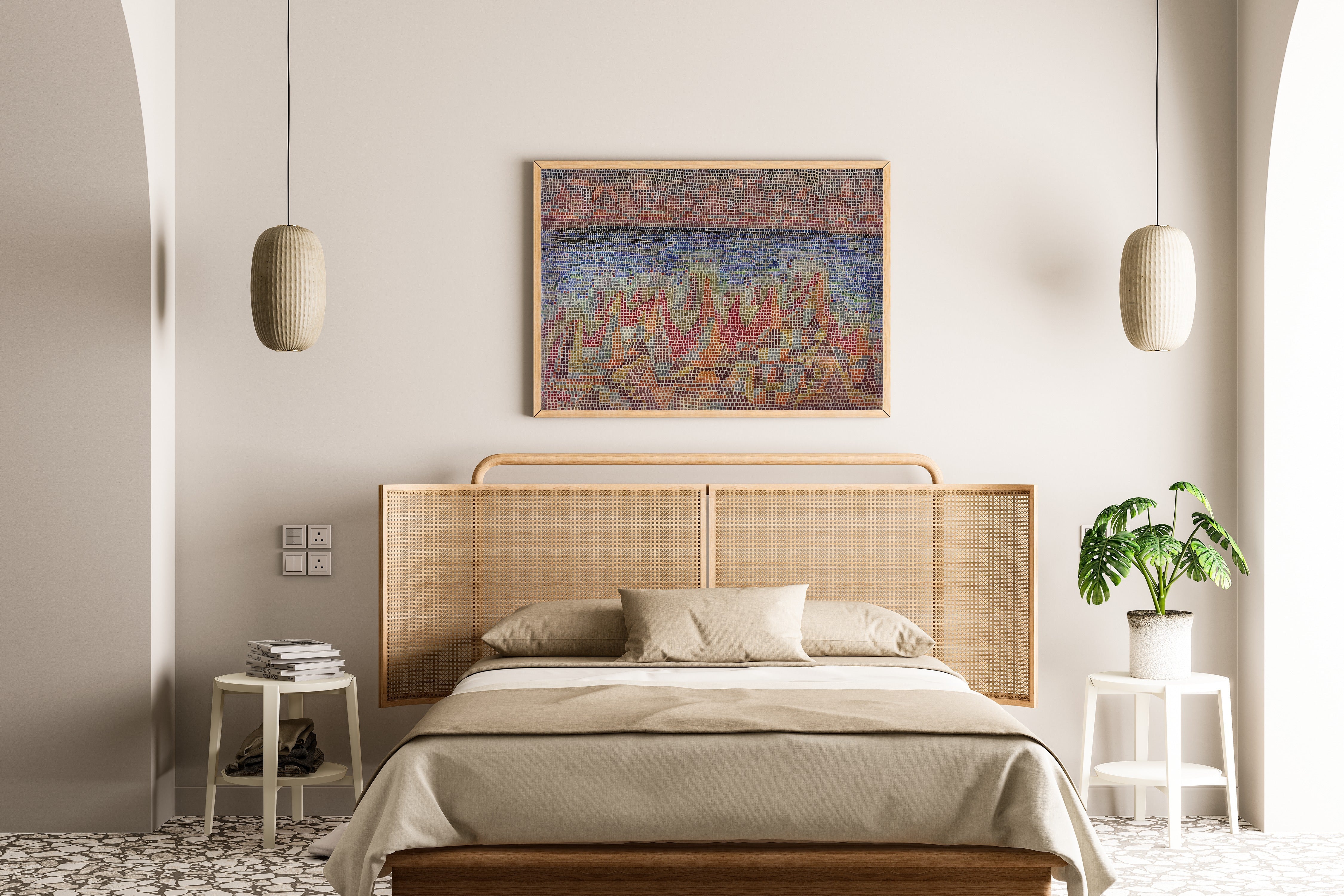
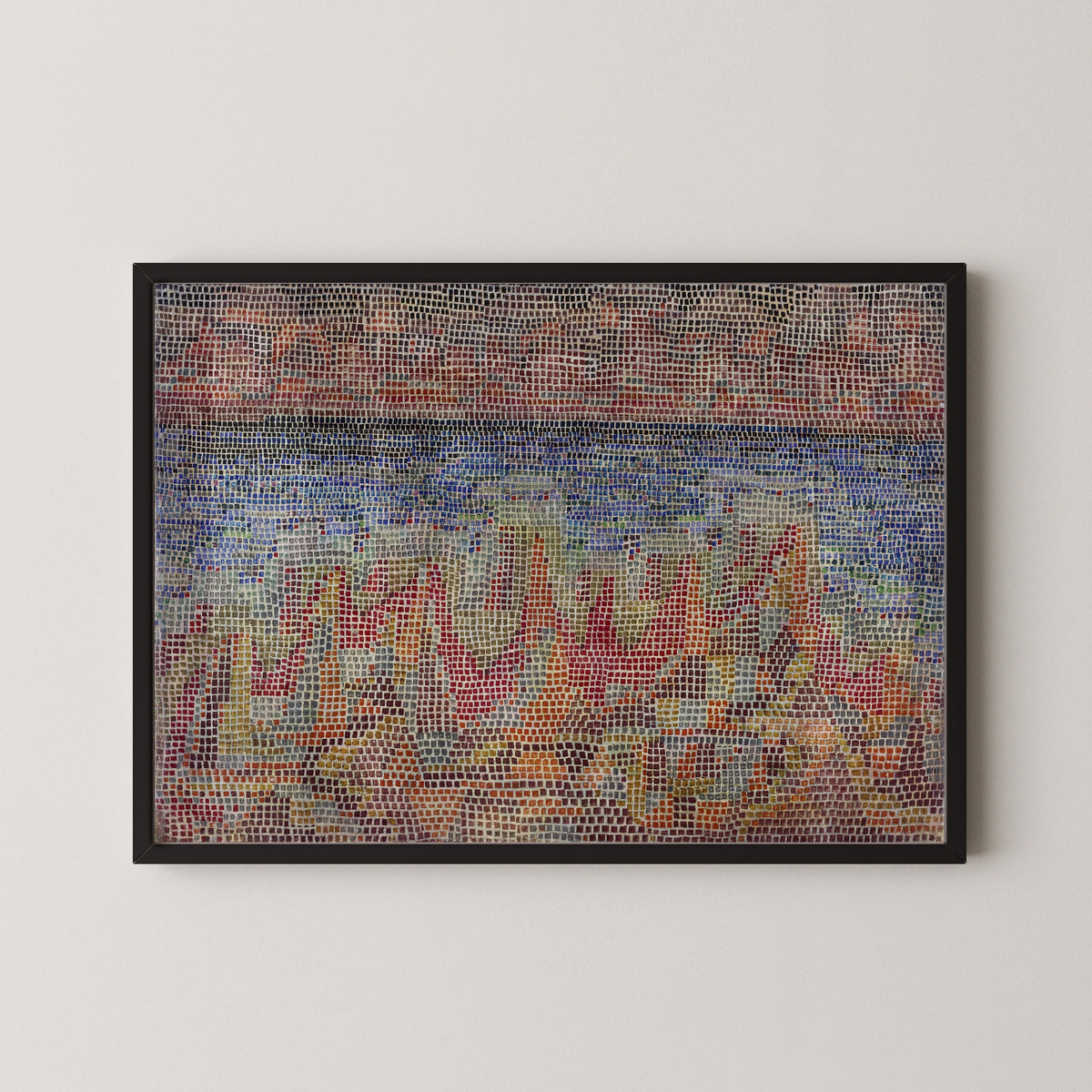
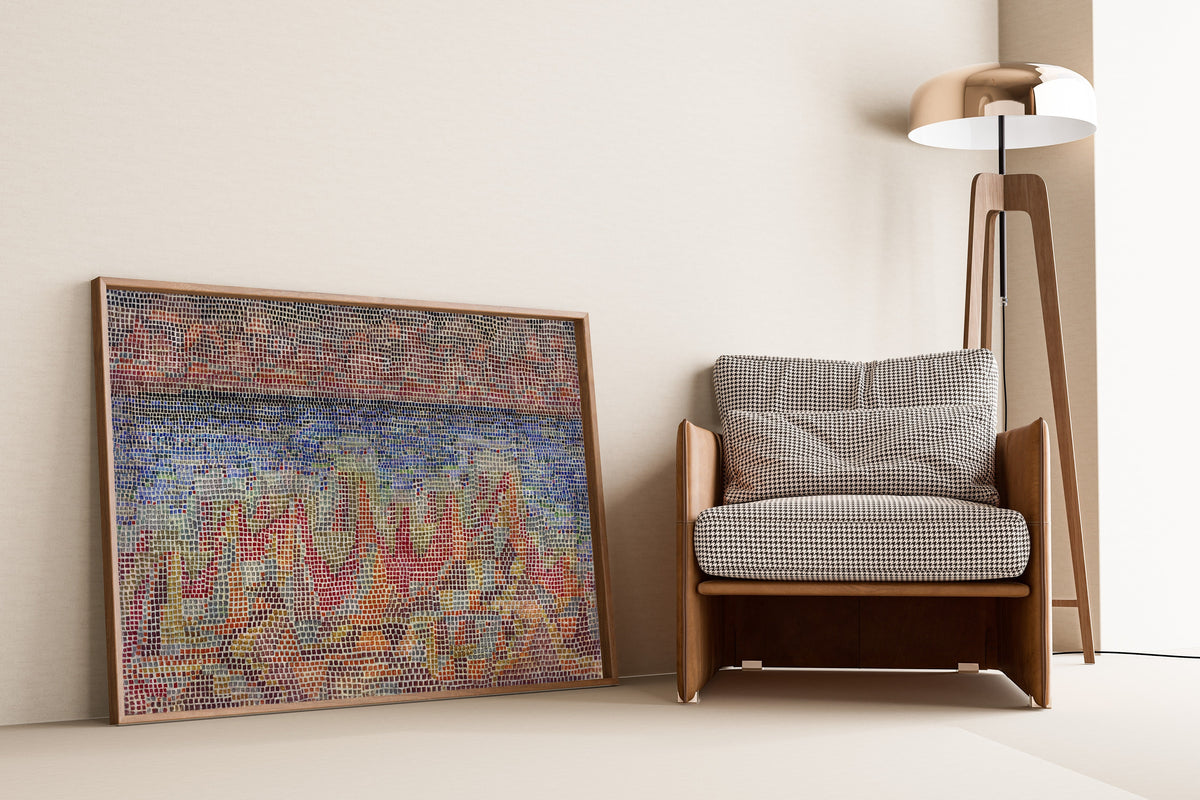
Mosaic-like dabs of color build layered cliffs above the sea
 The edge
 The weight
 The surface
Shown with Monet's Water Lilies.
The surface
Shown with Monet's Water Lilies.
Each frame is made to order by one of our framing workshops, so the exact shade and profile may vary slightly from the photos.
Small rectangular dabs of colour build a mosaic-like surface: pink, red, mauve and cream squares fill the sky band at the top above a dark horizontal line marking the horizon. Below it rows of blue and grey dabs suggest the water, giving way to jagged vertical formations in deep red, ochre, gold and grey that fill the lower two-thirds of the picture like layered cliffs, each shape built cell by cell.
Paul Klee (1879–1940) was one of the most inventive artists of the twentieth century. Swiss-born and trained in Munich, he joined Kandinsky and Marc in the Blaue Reiter circle, found colour on a journey to Tunisia in 1914, and taught at the Bauhaus from 1921 to 1931, where his lectures on line, tone and colour became a theory of pictorial form. His small paintings and drawings move between geometry, script, humour and dream. After the Nazi regime dismissed him in 1933 he returned to Bern. His work is held by the Zentrum Paul Klee in Bern, the Museum of Modern Art and the Metropolitan Museum of Art.
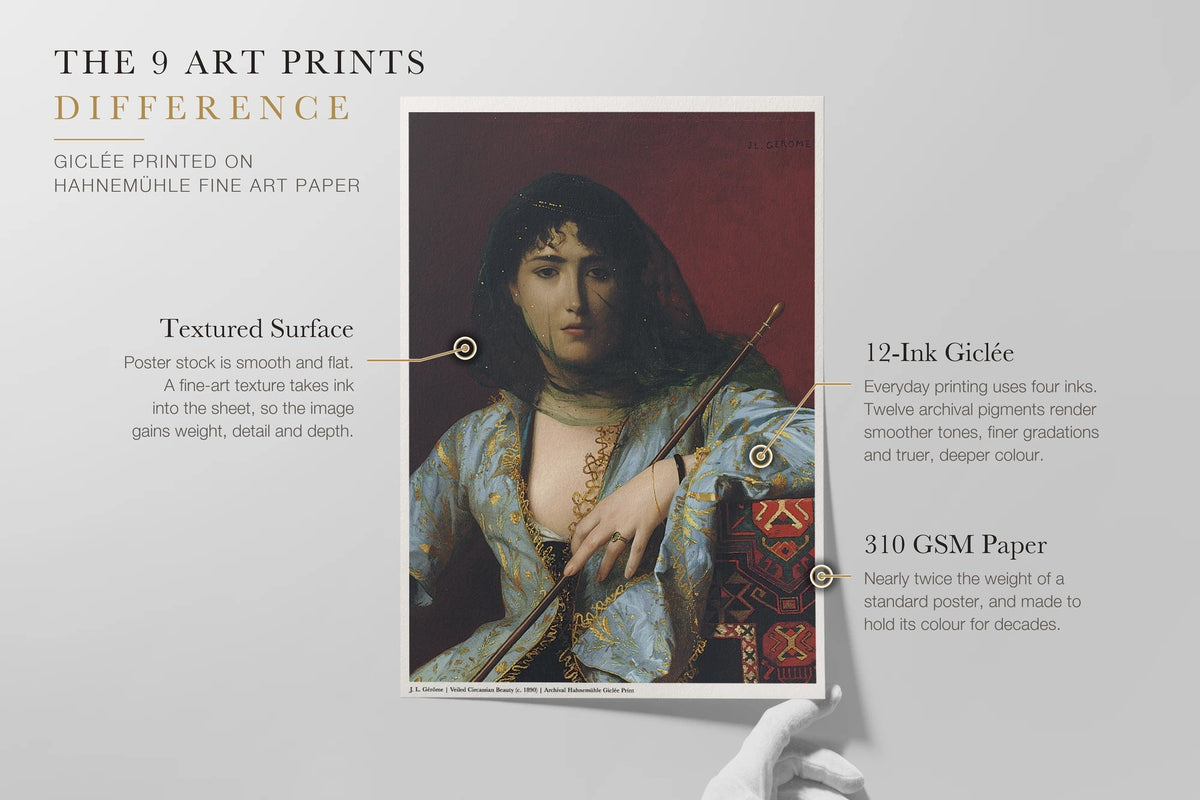
Each print is a giclée, printed to order. Unframed prints are made on Hahnemühle German Etching, a 310gsm matte fine-art paper. Framed prints are printed on 200gsm matte fine-art paper and arrive in a handmade solid-wood frame with low-reflection glazing, ready to hang. Ships worldwide with free delivery to 30+ countries.
Choose options
AMAZING Print and wonderful customer service. The quality is unmatched, I'm so happy
Joy T.
Félix Vallotton — Woman in RedThe print is colorful and pleasing to the eye. The paper is of high quality with good thickness that is great for display by itself or in a frame. A good price for the quality! Thank you!
Taylor H.
Hiroshi Yoshida — The WetterhornVrty nice print at very fair pricepoint. Comms with seller around shipping delay went smooth. Overall I'm very happy!
Y. L.
Kaoru Kawano — Girl with Yellow BirdFrom the collection
 Paul KleeA Cote de Provence
From $210 CAD
Paul KleeA Cote de Provence
From $210 CAD
 Paul KleeAbout the Town
From $210 CAD
Paul KleeAbout the Town
From $210 CAD
 Paul KleeMarks for Later
From $165 CAD
Paul KleeMarks for Later
From $165 CAD
 Paul KleePaul Klee - Bauhaus Vintage Mid-century Modern Abstract Art Print (available handframed or unframed) 1x1
From $165 CAD
Paul KleePaul Klee - Bauhaus Vintage Mid-century Modern Abstract Art Print (available handframed or unframed) 1x1
From $165 CAD
 Paul KleeBlue Night
From $210 CAD
Paul KleeBlue Night
From $210 CAD
 Paul KleeCity of Graves
From $165 CAD
Paul KleeCity of Graves
From $165 CAD
 Paul KleeCreeper and Climber
From $210 CAD
Paul KleeCreeper and Climber
From $210 CAD
 Paul KleeLandscape BL
From $210 CAD
Paul KleeLandscape BL
From $210 CAD
9 Art Prints was founded by author Arif Anwar around two simple ideas: that great art should reach far beyond the familiar Western canon, and that fine art reproductions should be made with exceptional materials.
So we seek out remarkable artists and traditions from around the world, then reproduce them using carefully sourced images, archival giclée printing, and fine art papers from Hahnemühle.
Read our storyWITH EVERY PRINT
Every work chosen by hand, delivered with free shipping and import duties covered, and a real person to help before and after you buy.
People do. Every work in the collection is chosen by hand, from the great names of art history to artists and traditions you rarely see as prints: Persian miniatures, South Asian painting, Bauhaus posters, Belle Époque illustration and much more.
Your print and delivery to your door. Shipping is free, and we cover import duties: if you are charged a duty when your print arrives, send the receipt to support@9artprints.com and we will reimburse you.
Always. Write to support@9artprints.com or call +1 (647) 455 2253, before you order or long after your print arrives. Choosing a size, asking about a custom size or a framing question: just ask.
We make it right at no cost. If your print arrives damaged, defective or not what you ordered, tell us and we will arrange a replacement or another fix. You won't need to send it back. Returns & guarantee
Unframed prints travel rolled in a protective tube. This is the standard and safest way to ship a print: a rolled sheet cannot be creased or have its corners knocked in transit. Framed prints arrive ready to hang.
Hahnemühle paper is very delicate. Its soft, textured matte surface marks far more easily than ordinary poster paper, so handle it with care. Wash and dry your hands first, or wear clean cotton gloves if you have them. Hold the sheet by its edges with both hands, and never touch the printed surface.
To flatten your print:
Frame your print behind glass as soon as you can, and keep it flat until then. Hang it out of direct sunlight and away from damp and heat, such as bathrooms and radiators. If it gathers dust, use a soft, dry brush; never water or cleaning products.
Unsure about anything? Any professional framer will know how to handle and flatten your print, and you can always write to us before you unroll it.
Our principal fine-art papers include Hahnemühle German Etching 310gsm and Hahnemühle Photo Rag 308gsm. German Etching has a substantial, lightly textured surface that works exceptionally well for paintings and richly coloured works. Photo Rag has a smoother cotton surface suited to graphic, modernist and highly detailed imagery.
Paper is selected according to the character of the artwork rather than using one generic stock for everything. Framed prints are printed on 200gsm matte fine-art paper.
Giclée is a fine-art printing process using archival pigment inks and high-resolution inkjet printing, made to reproduce subtle colour gradations, fine detail and tonal depth.
Large-format reproduction depends heavily on the quality of the underlying artwork file. We source the highest-resolution material available and prepare each image for print rather than simply enlarging a small internet image.
That is especially important with historic paintings, posters and archival works where source quality varies considerably.
Our framed pieces use solid-wood frames, handmade to order, with low-reflection glazing. There is no mount: the print fills the frame. Framed prints are printed on 200gsm matte fine-art paper.
Screens emit light; paper reflects it, so no physical print can be identical to every monitor or phone display. We prepare our artwork specifically for print and aim for accurate colour, contrast and tonal reproduction.
The texture and surface of fine-art paper also give the finished piece a physical depth that cannot be shown completely on a screen.
“I am not just impressed; I'm blown away by the quality and overall experience. The wood grain in the frame is beautiful and the print quality is superb.”
Top Quality Store on Google
Read the reviewsChosen by hand · Artists from every tradition · Shipping and duties covered · Hahnemühle paper