Article: The War of the Worlds, 1906: Alvim Corrêa's Martians and the Birth of Science-Fiction Art
The War of the Worlds, 1906: Alvim Corrêa's Martians and the Birth of Science-Fiction Art
This article is part of our Ultimate Fine Art Print Buyer's Guide.

If you want science-fiction art prints that look like serious art rather than a film poster, start in 1906. That year a young Brazilian artist living in Belgium, Henrique Alvim Corrêa, illustrated a deluxe French edition of H. G. Wells's The War of the Worlds. His drawings — sepia, smoky, frightening and beautiful — are still the best pictures anyone has made of Wells's Martians, and they hang on a wall like old master drawings.
In brief: For one dramatic image, choose a tripod over the Thames. For something quieter and stranger, choose a landscape where the machine is only a shape in the distance. For colour and graphic punch, choose the original 1906 publisher's poster. And for a reader who loves the book, any of them makes a gift they will not find anywhere else.
Who Alvim Corrêa was
Henrique Alvim Corrêa (1876–1910) was born in Rio de Janeiro, trained in Paris and settled in Brussels, where he worked as an illustrator. Wells saw his War of the Worlds drawings and approved them. The edition, published by L. Vandamme in 1906, was printed in only 500 numbered copies, with a hundred illustrations in the text and 32 full-page plates. Corrêa died four years later, aged 34. The book became a collector's item, and his Martians were largely forgotten until science-fiction collectors rediscovered them.
What makes the drawings special is that they are not technical. Later artists drew Wells's fighting machines as clean, shiny robots. Corrêa drew them as tall, spindly, almost organic things, half seen through smoke and rain — closer to a nightmare than a diagram.
The big scenes: tripods over London

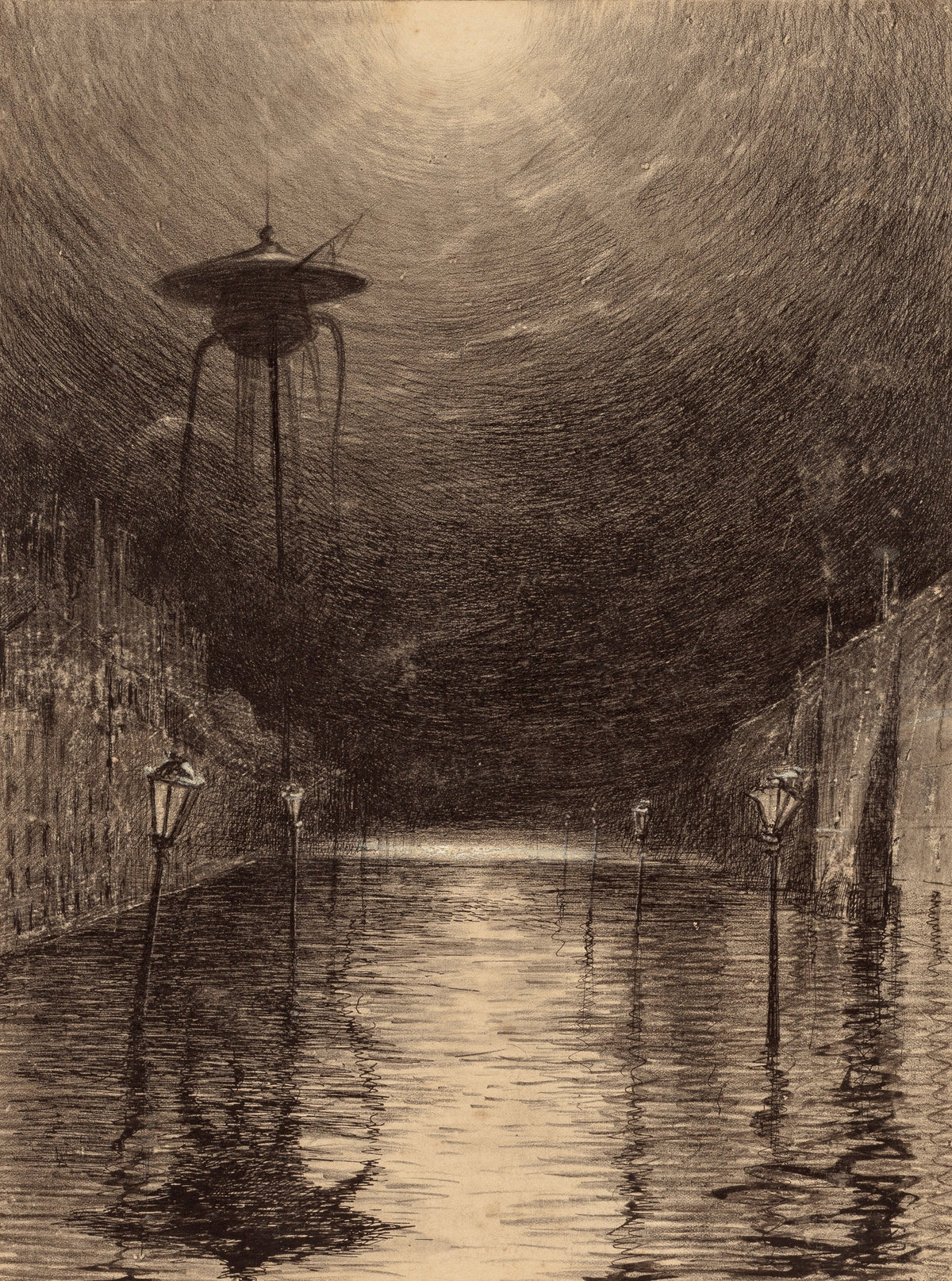
These are the pictures to choose if you want the story at full volume. In Martian Machine over the Thames, at the top of this page, a tripod stands at the end of a flooded street, its legs in the water, with a row of gas lamps leading your eye straight to it under a dark, swirling sky. In Martian Fighting Machine in the Thames Valley a tripod with long, coiling arms fires a pale beam across a river while a crowded boat goes down beneath it.
Room: study, home office, a hallway or the wall above a desk. Frame: black for drama, or natural oak to bring out the warm sepia.
The quiet, eerie ones

Some of Corrêa's best drawings barely show a Martian at all. Martian in the Forest is a dark wood beside a stream, with great twisted trunks in the foreground and, far off in the mist, the small upright shape of a tripod. Abandoned London is an empty, broken street with a ladder against a wall, rubble on the cobbles and a domed building looming behind. Falling Star looks out over rooftops and chimney pots at night as a streak of light crosses the sky — the first sign of the invasion.
These work like atmospheric landscape drawings. Guests see a moody 19th-century scene first and only then notice what is in it, which is exactly why they suit living rooms and bedrooms better than the battle scenes.
Room: living room, bedroom, reading corner. Frame: natural oak or brown walnut.
The strangest: from space

Martians Head Toward Earth is almost abstract: a huge pale sphere fills the sky, a small glowing shape falls away from it, and bats wheel through the darkness. Dead Martians is the end of the story — a wrecked machine lying in a pit beside a fallen panel of riveted metal, with birds circling and scaffolding in the background.
For colour: the 1906 poster

If the sepia drawings feel too dark, the publisher's poster for the book is the answer. La Guerre des Mondes, Vandamme Edition Poster shows a tripod rising out of billowing white smoke over orange flames, under a yellow banner with the title in Art Nouveau lettering, on a warm brown ground. It is the most graphic piece in the collection and the easiest to place in a modern room — see What Art Prints Make an Apartment Look Cool? for why vintage posters work so well in a flat.
Room: living room, kitchen, entrance. Frame: black or white.
A gift for the reader
These prints make an unusually good present for anyone who loves science fiction, H. G. Wells or old books: the art is museum-grade, the story is famous, and they are very unlikely to own it already. Our guide How to Buy Art Prints as a Gift Without Getting It Wrong covers size and framing when you cannot see their wall.
If you like the drama of black-and-white illustration, Corrêa sits naturally beside Gustave Doré — read Gustave Doré Prints: Dante, The Raven and the Engravings That Defined the Sublime. For more dark, strange and beautiful art, see Symbolist and Mystic Art for Autumn Walls.
Paper and framing
Every print is made on Hahnemühle fine art paper with archival pigment inks. Pencil, charcoal and wash drawings like Corrêa's need a matte surface: the soft greys and smoky skies keep their depth instead of turning shiny. Framed prints come in black, white, natural oak and brown walnut.
Summary: A tripod over the Thames for drama, a forest or abandoned street for quiet unease, the 1906 poster for colour. All of them are 120-year-old drawings that still look startlingly modern.
Keep exploring the Henrique Alvim Corrêa, Science Fiction and Fantasy & Sci-Fi Illustration collections, or see Posters That Outlived the Films.