Article: Ivan Bilibin Prints: Russian Fairy Tales for Grown-Up Walls
Ivan Bilibin Prints: Russian Fairy Tales for Grown-Up Walls
This article is part of our Ultimate Fine Art Print Buyer's Guide.

Fairy-tale art prints usually mean nursery pictures. Ivan Bilibin's do not. His Russian fairy tales from the early 1900s have the flat colour and strong outline of a Japanese woodblock, the decorative borders of a medieval manuscript and a darkness that grown-ups enjoy more than children: witches, skull lanterns and riders in deep forest. They look as good in a hallway or a study as they do in a child's room.
In brief: For something wonderfully strange, choose Baba Yaga or Vasilisa with the skull lantern. For colour and movement, choose one of the sea scenes from Tsar Saltan. For pattern and lettering, choose a book cover. For a child's room that will grow with them, the Vasilisa pictures work at any age.
Who Bilibin was
Ivan Bilibin (1876–1942) was a Russian illustrator who made his name at the turn of the century with a series of fairy-tale books printed by the state printing works in St Petersburg. He travelled in northern Russia studying wooden churches, embroidery and folk carving, and you can see all of it in his borders. Like many artists of his generation he also loved Japanese prints, and his waves owe a clear debt to Hokusai. He left Russia after the Revolution, worked in Cairo and Paris, returned home in 1936 and died during the siege of Leningrad.
Vasilisa and the witch: the dark ones

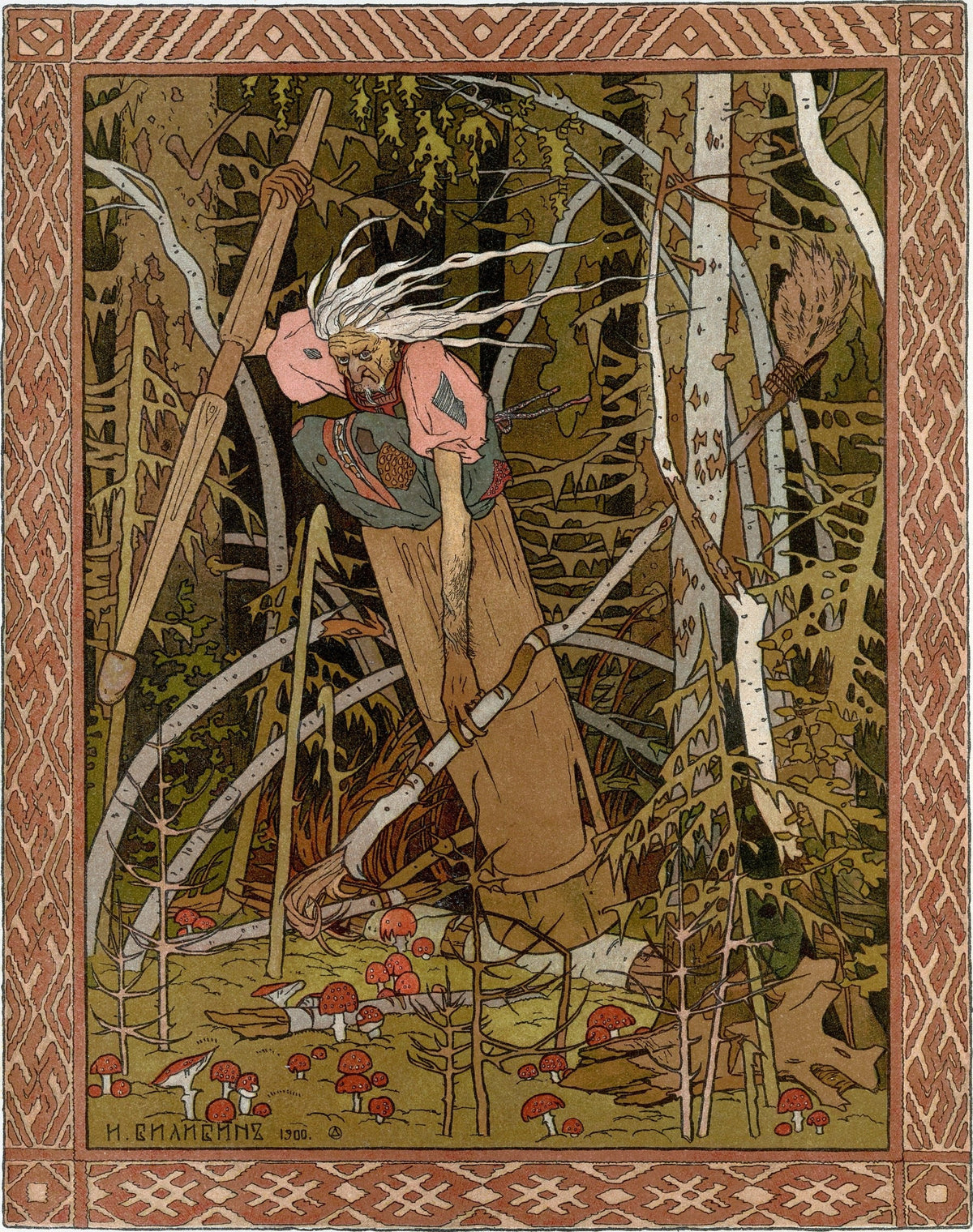
The story of Vasilisa the Beautiful is the one to know. Sent into the forest to fetch fire from the witch Baba Yaga, Vasilisa meets three horsemen — white for morning, red for the sun, black for night — and comes home carrying a skull whose eyes burn. In Vasilisa the Beautiful and the Skull Lantern she walks through a dark wood in a white embroidered blouse and long plait, holding the glowing skull on a stick, with the witch's hut and more skulls on posts behind her. Baba Yaga, at the top of this page, is the witch herself, wild white hair streaming as she flies between the birch trees in her mortar over a carpet of red toadstools.

The horsemen make a natural set. Vasilisa and the Black Horseman shows the rider of night on a dark horse among fir trees, a low pink sun behind him, inside a border of folk birds. In Vasilisa and the White Horseman Vasilisa, with her staff, stops among the birches as a pale rider on a white horse passes behind the trees. Hang two or three side by side and they read as one story.
Room: hallway, study, a dining room with dark walls, an older child's bedroom. Frame: natural oak or brown walnut, which suit the earthy greens and browns.
Tsar Saltan: the sea

Bilibin's illustrations for Pushkin's Tale of Tsar Saltan (1905) are brighter and more graphic. In The Barrel Floats upon the Sea a wooden barrel — carrying the banished queen and her son — rides a huge curling green wave under a sky full of stars, above a band of red-and-blue folk pattern. The Ship at Sea is a red ship cutting through rows of green-and-white waves towards an island city on the horizon. And The Thirty-Three Bogatyrs is a whole book page: a long line of knights in red armour marching out of the sea at night, with Pushkin's verse printed below.
If you love Japanese woodblock waves, these are the obvious companion — see Best Japanese Woodblock Prints for Modern Homes.
Room: living room, bathroom, a child's room. Frame: white or black.
Covers and lettering

For pure decoration, look at the covers. Pushkin's Fairy Tales, Front Cover sets a panel of ornate Cyrillic lettering between rolling waves and rows of knights, under a great oak tree with a black cat walking along its chain — the opening image of Pushkin's poem Ruslan and Lyudmila. It works like a piece of textile design and suits a modern room with plain furniture.
Framing borders and pairing
Most of Bilibin's pictures come with their own painted border, which means they already look finished. A simple frame is all they need. If you would like a mat on top of that, our guide Should I Get My Art Print Mounted? explains when a mat helps and when it crowds the picture.
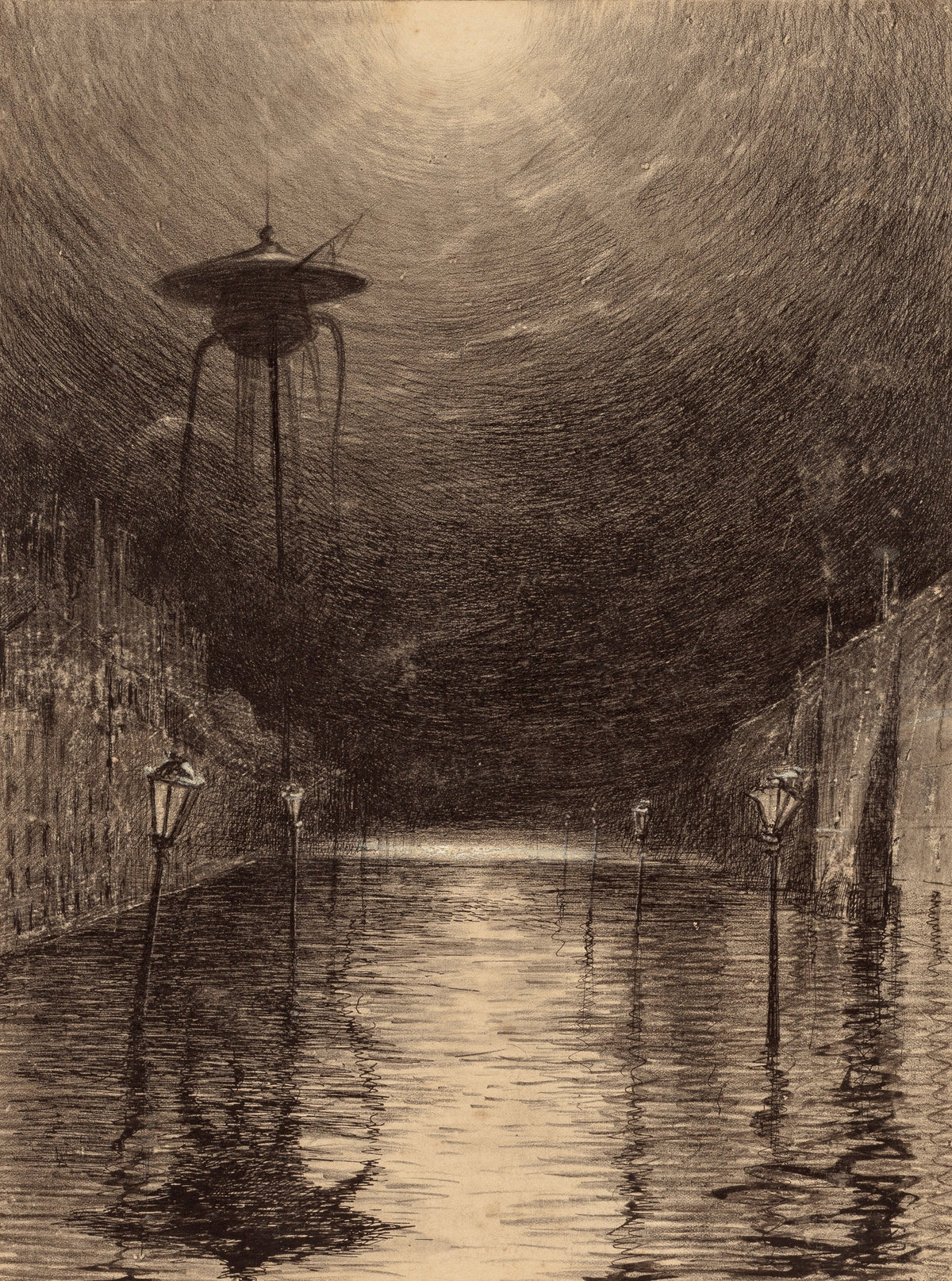
Bilibin pairs well with other storytellers. Gustave Doré's black-and-white fairy tales are in our Gustave Doré guide, and for something stranger still, read The War of the Worlds, 1906: Alvim Corrêa's Martians. If you are buying for someone else — these make a lovely present for a new parent or a reader of Russian literature — see How to Buy Art Prints as a Gift Without Getting It Wrong.
Every print is made on Hahnemühle fine art paper with archival pigment inks, which keeps Bilibin's flat colours rich and his fine black outlines crisp. Framed prints come in black, white, natural oak and brown walnut.
Summary: Baba Yaga and the skull lantern for wonderful strangeness, the Saltan seascapes for colour and movement, the covers for pattern. Fairy tales, but for grown-up walls.
Keep exploring the Fantasy & Fairy Tale, Mythology and Classic Illustration & Engraving collections.