Hiroshi Yoshida Prints: Clouds and Mountains — Which Yoshida Belongs on Your Wall
This article is part of our Ultimate Fine Art Print Buyer's Guide.

Hiroshi Yoshida climbed before he printed. He was a mountaineer, and his mountain prints were made by a man who had stood on the ridge at five in the morning and watched the cloud come up the valley. That is why they look different from every other Japanese landscape print: the air in them has weight, the snow has a time of day, and the summit is never a symbol. It is a place he had been.
If you want one on your wall, the choice is not between a good Yoshida and a bad one. It is between four kinds of mountain, and each of them asks for a different room.
In brief: Yoshida's mountains fall into four groups — Fuji, the cloud seas at dawn, the Japan Alps, and the peaks he drew abroad in America, Canada and Switzerland. Fuji holds a big bright wall. The dawn prints belong above a bed. The Alps suit a study or a landing. The foreign peaks are the ones for a living room with a lot of daylight. Then go one size larger than feels safe.
Who Yoshida was, briefly
Yoshida Hiroshi (1876–1950) trained as a Western-style painter, in oil and watercolour, and spent the first half of his career as a travelling landscape painter — he crossed to America for the first time in 1899 and sold his watercolours there to pay his way. He came to the woodblock late, in his forties, and unlike most artists of the shin hanga revival he did not hand his designs to a publisher. After the 1923 earthquake he set up his own workshop, chose his own carvers and printers, stood over every stage, and sometimes cut the blocks himself. Prints made under his supervision carry a small mark in the margin — jizuri, "self-printed" — and those are the ones people mean when they talk about a Yoshida.
His method was patient to the point of stubbornness. A single print might go through dozens of separate impressions, one colour at a time, and he was known to print the same set of blocks in different colours to make morning, afternoon, evening and night from one drawing. The mountains are where that patience shows most, because mountain light is mostly gradation, and gradation is the hardest thing a woodblock can do.
If shin hanga is new to you — the movement that revived the collaborative woodblock in the 1910s and 20s — What Is Shin Hanga Art? covers it properly, and our guide to Kawase Hasui covers the other great landscape printmaker of the movement.
The four Yoshidas
1. Fuji

Every Japanese printmaker drew Fuji. Yoshida drew it as a climber sees it — close, enormous, with the snow lying in long streaks down the dark flanks rather than sitting on top like icing. Fujiyama from Gotemba is the mountain filling the sheet with almost nothing in front of it. Fuji from Lake Kawaguchi puts a winter road and a channel of open water in the foreground, so the eye travels to the peak instead of arriving there at once.
These are the prints with the widest tonal range in the group — a white summit, a near-black base, a pale sky — and that range is what lets them hold a large wall in daylight. They are the Yoshidas to put above a sofa or on the long wall of an open-plan room, and they carry enlargement without losing anything.
Room: living room, open-plan spaces, any large bright wall. Frame: black or dark walnut, to anchor the white of the summit.
2. Cloud seas and the pink hour

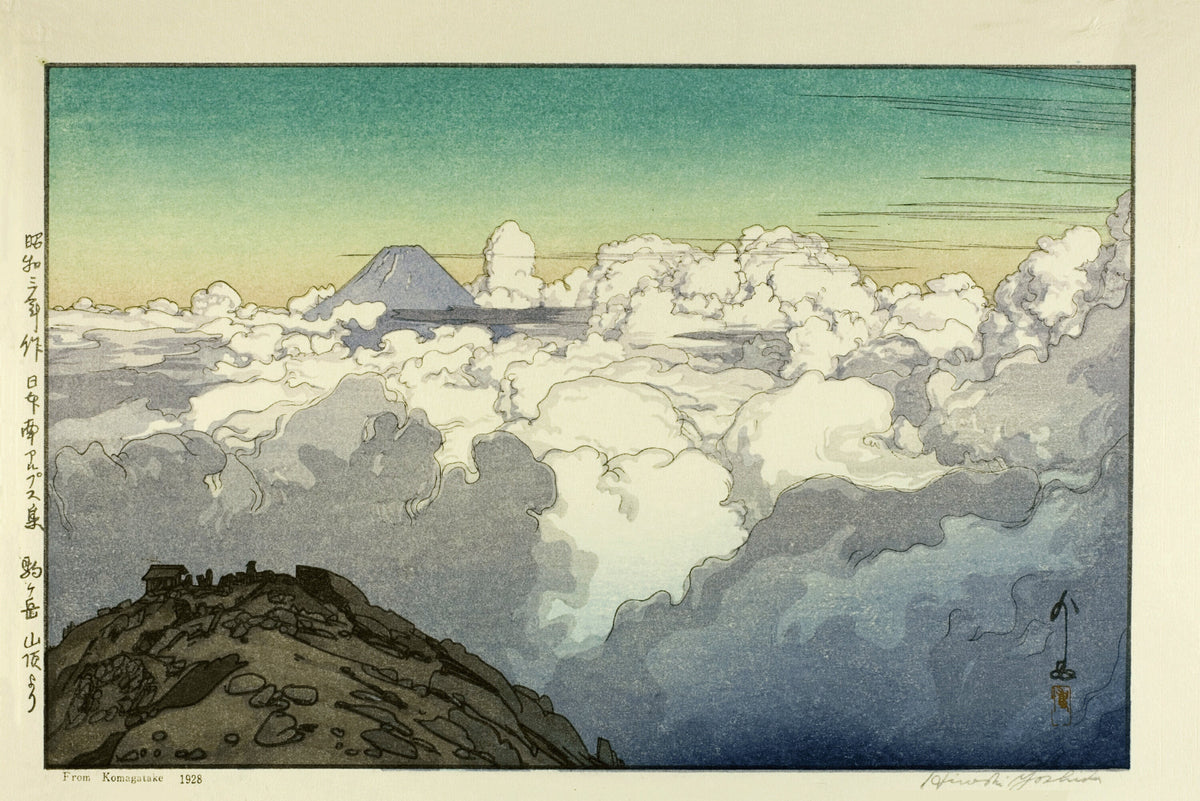
The second group is the one that only a climber could have made. Komagatake is a sea of cloud seen from above, lapping a dark ridge, with Fuji standing small and far off in the first light. Itoigawa Morning is a range of pink summits repeated whole in still water, with a town in silhouette between the two. Both are built almost entirely from gradation: grey into white, white into rose, and nothing in the picture with a hard edge.
That softness is why they work where the light is low and the room is quiet. Above a bed they are exactly right — you see them last thing at night and first thing in the morning, which is the hour they were drawn in. In a bright, busy room they fade into the wall.
Room: bedroom, a reading corner, a quiet study. Frame: natural oak or white; the paper is doing the work and a heavy frame fights it.
3. The Japan Alps

In 1926 Yoshida published a series on the Japan Alps, the high range in the middle of Honshu that he had climbed for years. Yarigatake is the rock spire of the "spear peak" above a snowfield, with two climbers at the bottom edge for scale, drawn in greys so close together that the mountain seems to be dissolving into its own weather. Mount Hodaka is the opposite: a sunlit meadow and spring birches in front, and the grey wall of the mountain behind, the whole thing lit from the side like late afternoon.
These are the most personal of his prints and the most restrained in colour. They read best at close range, where you can see how the gradations were laid, so they belong somewhere people stand rather than sit — a landing, a hallway, the wall beside a desk.
Room: study, landing, hallway. Frame: black for Yarigatake, oak for Hodaka.
4. The travelling years: Yosemite, the Rockies, the Alps

Between 1923 and 1925 Yoshida travelled through the United States, Canada and Europe, and the prints he made from that journey are the ones that surprise people, because nobody expects a Japanese woodblock of Yosemite. El Capitan is the granite wall catching the last light above its own reflection. Mount Rainier doubles itself in a meadow pool. Moraine Lake, in the Canadian Rockies, is the tallest and coldest of the set. From Switzerland, The Matterhorn rises over a village of pink-walled houses, and The Wetterhorn has a single blossoming tree on a green slope beneath the snow.
These are the most saturated prints in the group — blue water, blue sky, green meadow — and the most Western in their composition, which makes them the easiest Yoshidas to live with in a modern room. They hold their colour in daylight and they sit happily next to furniture that is not remotely Japanese.
Room: living room, dining room, kitchen — anywhere bright. Frame: walnut or black. For the tall ones (El Capitan, Moraine Lake, the Matterhorn) a narrow wall between two windows is ideal.
Size: the mistake people actually make
Yoshida's originals were mostly oban sheets, roughly 38 by 25 centimetres, and it is tempting to reproduce a mountain at something close to that out of respect for the object. In a modern room it is nearly always too small. A mountain print that is too small reads as a postcard; the same print one size up reads as a window.
The working rule is that art above furniture should span roughly 60 to 75 per cent of the width of the furniture beneath it. Over a three-seat sofa that means one large print, or two or three read as one arrangement. Yoshida's mountains enlarge better than almost any woodblock, because the drama is in broad gradations rather than fine line. Two guides go deeper: What Art Print Size Should I Buy for My Sofa, Bed, or Dining Room Wall? and the Fine Art Print Size Guide.
Why the paper matters more than usual here
A gradation in a woodblock print was made by wiping pigment across a damp block with a brush and pressing paper into it by hand, so the colour sits in the tooth of the sheet and thins out in it. Reproduce that on smooth glossy stock and the sky goes flat and the snow goes plastic.
Our Yoshida reproductions are printed on Hahnemühle German Etching, a 310 gsm textured fine art paper, using a twelve-ink archival pigment process. The texture gives the gradations somewhere to live, which is what your eye expects from the original. Textured Fine Art Paper vs Smooth Matte Paper explains when that choice is right and when it is not.
Where to start: eleven peaks, one decision
If you like Yoshida but do not want to work through a hundred images, we have made the choice smaller. Clouds and Mountains is eleven of his mountain prints — Fuji from two directions, the cloud seas, the Japan Alps, and the peaks from his years abroad — chosen so that any two or three of them hang together without fighting.
Buy one and you have a considered print. Buy two or three and you have an arrangement that looks deliberate, because the palettes were chosen to agree. The pairing logic is covered in The Art of Art Sets.
If you want to go wider
Yoshida drew a great deal besides mountains — temple gates, Indian palaces, sailing boats at every hour of the day — and the full Hiroshi Yoshida collection holds all of it. Shin Hanga Masters holds the rest of the movement, and if it is mountains you want regardless of who drew them, Mountains Art Prints runs across artists and centuries.
Summary: Match the Yoshida to the room's light. Fuji and the foreign peaks for big bright walls, the cloud seas for the bedroom, the Japan Alps for the study and the landing. Then go one size larger than your instinct.