Kawase Hasui Prints: Rain, Moonlight and Silence — Which Hasui Belongs in Your Home
This article is part of our Ultimate Fine Art Print Buyer's Guide.

Kawase Hasui made around six hundred prints in his lifetime, and a surprising number of them are rain, snow, or the last twenty minutes of daylight. If you have found your way to his work and want one on your wall, the problem is not finding a beautiful Hasui. Nearly all of them are beautiful. The problem is that a Hasui that transforms a bedroom can disappear completely in a bright open-plan living room, and the difference has almost nothing to do with which print is better.
In brief: Hasui's prints divide into four moods — rain, snow, moonlight, and blue-hour water. Rain and snow suit quiet rooms where people slow down. Moonlight suits rooms lit warmly at night. Blue-hour water is the one that holds a large bright wall. Choose by the mood the room already has, then size the print to the furniture beneath it.
Who Hasui was, briefly
Kawase Hasui (1883–1957) came to printmaking late, in his mid-thirties, after being turned away from a painting master's studio and spending years in the family business. He found his subject almost immediately: Japan seen at the hour when the light is doing something. He worked in the shin hanga system, which revived the old collaborative method of ukiyo-e — the artist designs, a carver cuts the blocks, a printer pulls the impressions, a publisher coordinates the whole thing. His publisher was Watanabe Shozaburo, and the partnership lasted most of Hasui's career.
In 1923 the Great Kanto earthquake destroyed Watanabe's premises, and with them Hasui's original blocks and nearly all of his sketchbooks. He started again. The work after that fire is the work most people know. In 1956, the year before his death, the Japanese government designated his woodblock technique an Intangible Cultural Property.
If the collaborative method and the difference between shin hanga and ukiyo-e are new to you, What Is Shin Hanga Art? covers it properly.
The four Hasuis
1. Rain

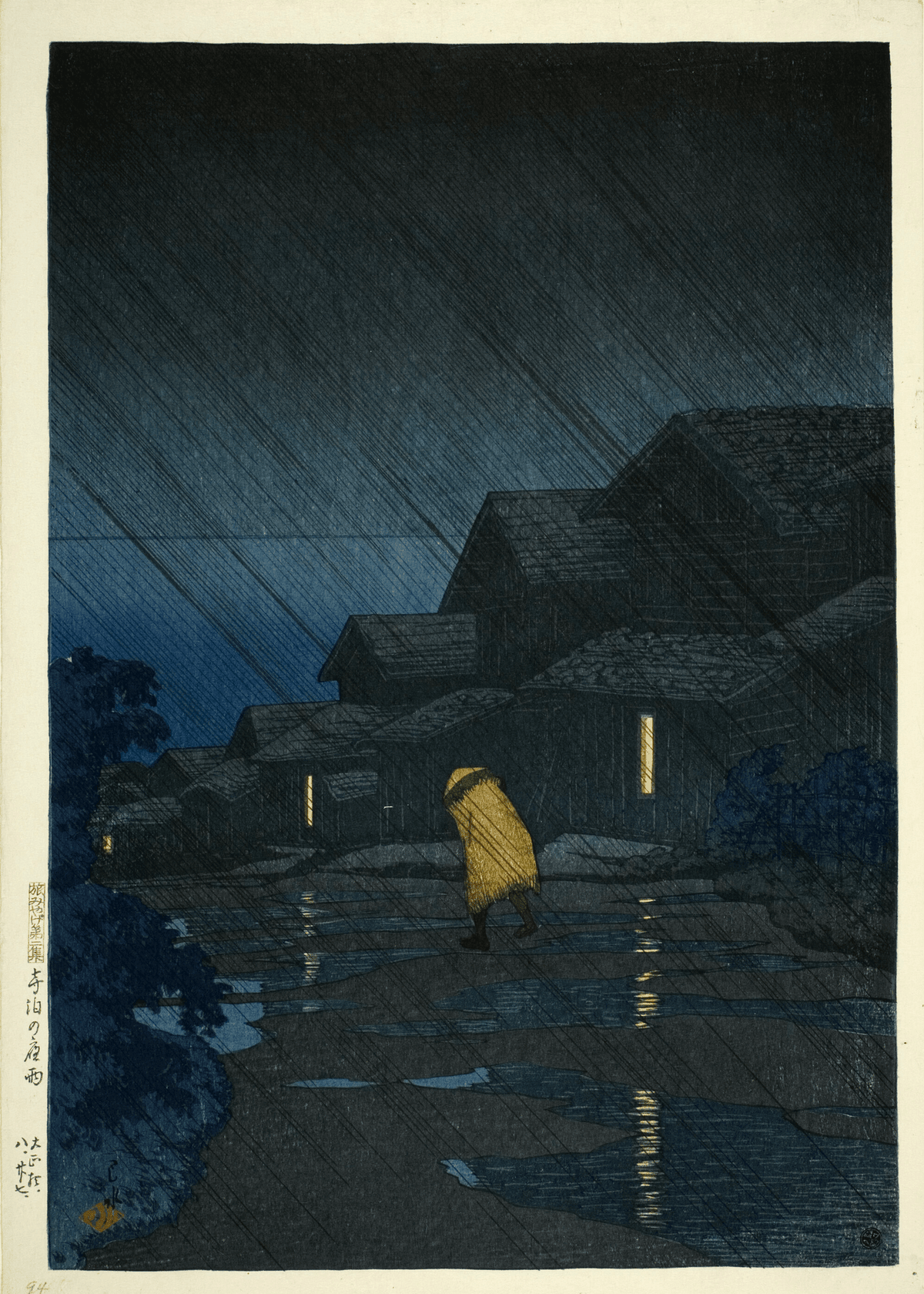
Rain is the Hasui most people meet first. He drew it as fine diagonal lines cut into the block, laid over water and roofs and lantern light, and the effect is of a scene you are watching from indoors. Rain at Teradomari and Rain at Ushibori are the two to look at first. Rain at Kiyomizu Temple is the same weather against architecture rather than water.
These are quiet prints with a narrow tonal range — greys, blue-greys, a single warm point of lamplight. They work where the room is already calm and the light is low or indirect: bedrooms, a reading corner, a home office that faces a wall rather than a window. In a bright south-facing room they flatten out.
Room: bedroom, study, reading corner. Frame: black or dark walnut, which picks up the darkest passages and keeps the print from floating.
2. Snow

Snow gives Hasui something rain does not: large areas of empty paper. Winter at Kamigamo, Kyoto and Saishoin Temple, Hirosaki are built around white, with the composition carried by a few dark verticals — a gate, a pine, a figure under an umbrella.
That emptiness is why snow prints read well in circulation spaces. A hallway or stairwell is somewhere people move through rather than sit in, and a print that resolves in two seconds at walking pace is exactly right there. The same quality makes them useful above a low sideboard in a room that is otherwise busy.
Room: hallway, stairwell, entry, a busy room that needs a quiet patch. Frame: natural oak or white; the paper is doing the work and a heavy frame fights it.
3. Moonlight and night

The night prints are the deepest in colour and the most dramatic. Moon Over Magome, Evening at Matsuyama Castle and Tagonoura Bridge all use a nearly black ground with one source of light in it.
Here is the thing worth knowing: these prints change completely depending on the light in the room. Under a bright overhead they can go flat and murky. Under warm lamplight in the evening they open up, and the moon reads as a moon. That makes them ideal for rooms you mainly use after dark — a living room lit by lamps, a dining room, a bar area — and a poor choice for a daylit kitchen.
Room: living room, dining room, any room you use in the evening. Frame: black. Glazing: worth paying for low-reflection glazing here, because dark prints show every reflection.
4. Blue-hour water and bridges

The fourth group is the one people overlook, and it is the one that solves the hardest wall. Shin Ohashi Bridge, Lake Teganuma and Lake Towada sit in the blue half-hour before night, with strong horizontal structure and enough saturation to hold their own in daylight.
If you have a large bright wall — the sofa wall in an open-plan room, the long wall of a modern flat — this is the Hasui to buy, at the largest size the wall will take.
Room: living room, open-plan spaces, any large bright wall. Frame: black or walnut, and go bigger than feels safe.
Size: the mistake people actually make
Hasui's original prints were modest — most were oban size, roughly 39 by 26 centimetres. It is tempting to reproduce them at something close to that out of respect for the object. In a modern room, that is usually too small, and a print that is too small is the most common regret we hear about.
The working rule is that art above furniture should span roughly 60 to 75 per cent of the furniture's width. Over a three-seat sofa that means one large print, or a pair or trio read as one arrangement. Hasui's compositions carry enlargement well because they were designed in flat colour areas with clean edges rather than fine brushwork.
Two guides go deeper: What Art Print Size Should I Buy for My Sofa, Bed, or Dining Room Wall? and the Fine Art Print Size Guide. If you want the short version of what people wish they had done differently, read The 3 Biggest Art Print Buying Regrets.
Why the paper matters more than usual here
A woodblock print was pressed by hand into dampened paper. The surface has tooth, and the colour sits in it rather than on it. Reproduce that on thin glossy stock and the image survives but the object does not — it reads as a picture of a print rather than a print.
Our Hasui reproductions are printed on Hahnemühle German Etching, a 310 gsm textured fine art paper, using a twelve-ink archival pigment process. The texture does something specific for shin hanga: it gives the flat colour areas a surface, which is what your eye expects from the original. Textured Fine Art Paper vs Smooth Matte Paper explains when that choice is right and when it is not.
Where to start: seven prints, one decision
If you like Hasui but do not want to work through two hundred images, we have made the choice smaller. Rain, Moonlight & Silence is a set of seven prints covering all four moods — rain, snow, moonlight, water — chosen so that any two or three of them hang together without fighting.
Buy one and you have a considered print. Buy two or three and you have an arrangement that looks deliberate, because the palettes were selected to agree. The pairing logic is covered in The Art of Art Sets.
If you want to go wider
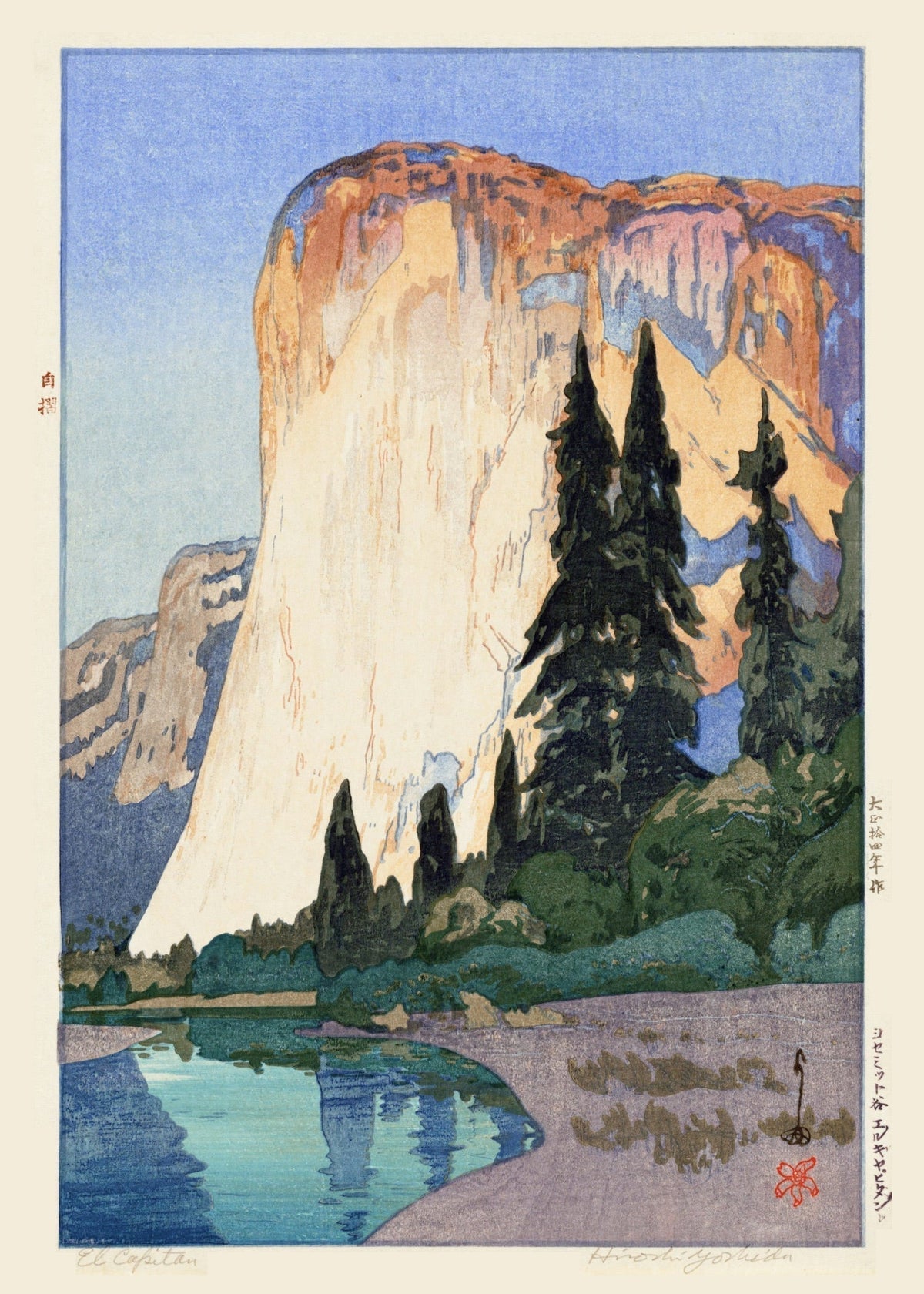
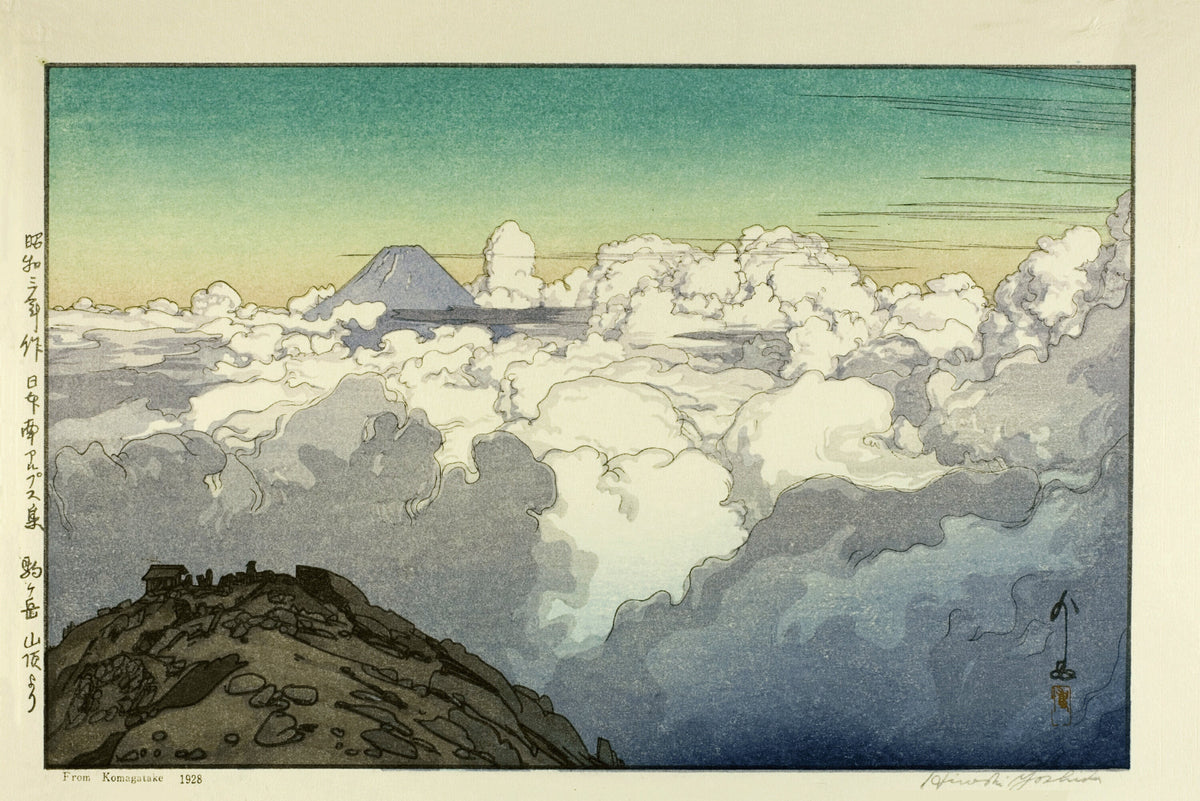
Hasui is one artist inside a movement. Shin Hanga Masters holds the rest — Hiroshi Yoshida's mountains and Ito Shinsui's portraits among them. If it is specifically the night scenes that draw you, Night & Moonlight Art Prints runs across artists and centuries.
Summary: Match the Hasui to how the room is lit and how it is used. Rain and snow for quiet rooms and passages, moonlight for rooms you use after dark, blue-hour water for big bright walls. Then go one size larger than your instinct.