Best Japanese Woodblock Prints for Modern Homes
This article is part of our Ultimate Fine Art Print Buyer's Guide.

Japanese woodblock prints are two hundred years older than the modern interior and they suit it better than most things made this century. That is not nostalgia. It is a structural match, and once you see why, choosing one gets much easier.
In brief: Japanese prints work in contemporary rooms because they were designed in flat areas of colour with hard edges, restrained palettes, and deliberate empty space — the same visual grammar modern interiors use. Shin hanga prints (roughly 1915–1960) read as the most contemporary; ukiyo-e reads more as pattern. Ten specific starting points are below, sorted by the room they belong in.
Why they work in a modern room
Four reasons, and they are worth understanding because they also tell you which prints to avoid.
Flat colour, hard edges. A woodblock print is built from separate blocks, one per colour. That forces the design into clean shapes with defined boundaries — no blended modelling, no fussy transitions. Put one next to a painted wall, a plain sofa, a run of cabinetry, and the shapes agree.
Limited palettes. Each additional colour meant another block, another carving, another pass through the press. Economy was built into the medium, and the results rarely fight a room's existing colour scheme. Most prints here run on four to eight colours.
Deliberate emptiness. Japanese composition treats unprinted paper as an active part of the design rather than a gap to be filled. Contemporary interiors do the same thing with wall space. A print with real emptiness in it makes a wall feel considered rather than covered.
Horizontal formats. A great many of these prints are landscape-oriented, and the walls that most need art in a modern home — above a sofa, above a sideboard, above a bed — are horizontal.
Shin hanga or ukiyo-e? A thirty-second answer
Ukiyo-e is the older tradition — Hokusai, Hiroshige, Utamaro, roughly the seventeenth to nineteenth centuries. Bold outlines, decorative pattern, often figures and narrative. In a room it behaves like strong graphic pattern.
Shin hanga means “new prints” — a twentieth-century revival that kept the old collaborative workshop (artist, carver, printer, publisher) but absorbed Western ideas about light, atmosphere and perspective. Hasui, Yoshida, Koson, Shinsui. In a room it behaves like quiet atmospheric photography.
Neither is better. If your home is spare and modern and you want the art to settle the room, start with shin hanga. If your room is neutral and you want the art to be the event, ukiyo-e earns its place. What Is Shin Hanga Art? goes further.
Ten starting points, by room
Living room — the large wall
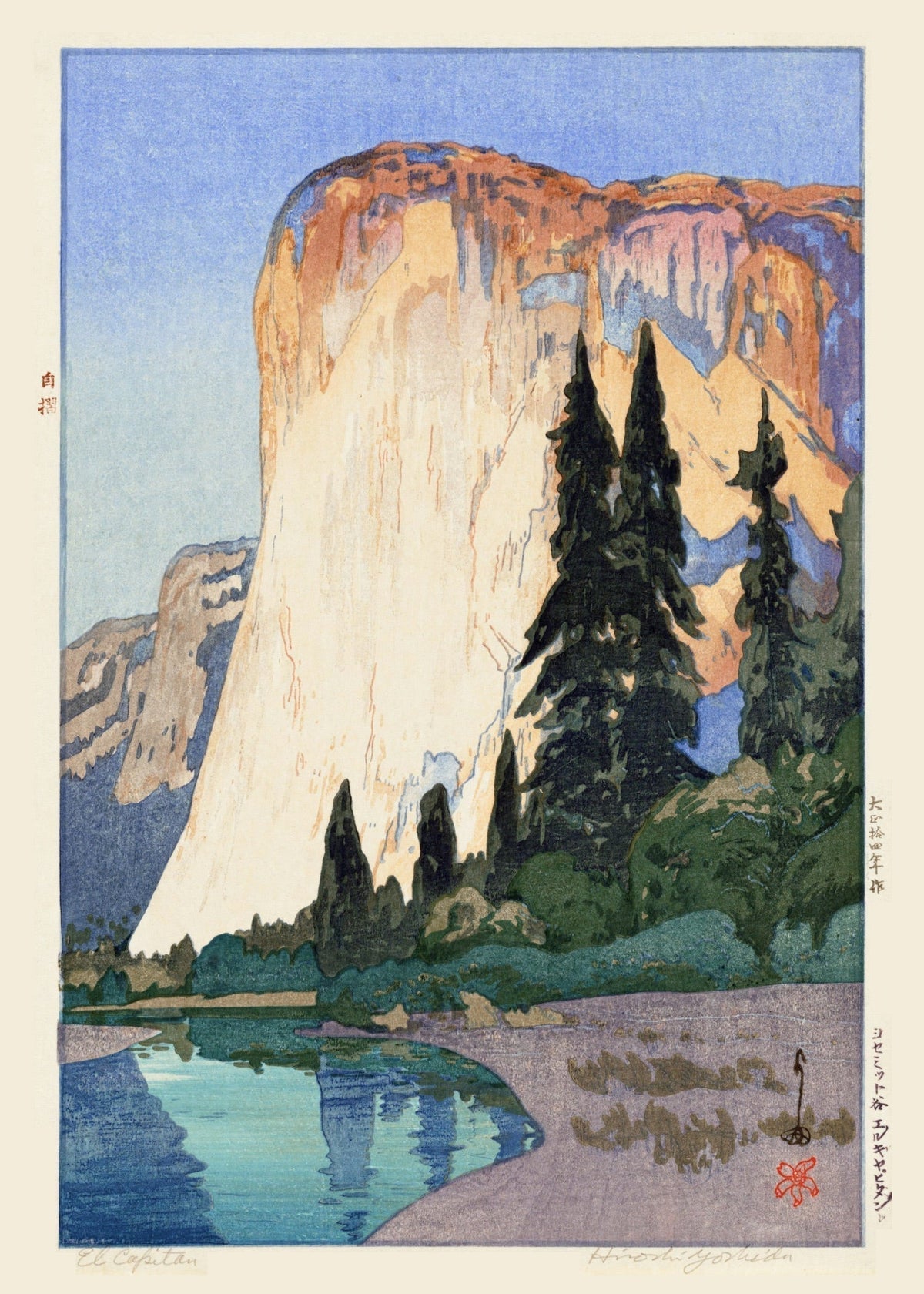
1. Hiroshi Yoshida, El Capitan. Yoshida travelled and painted the American West, the Alps, the Himalayas, and he printed them with Japanese blocks. A granite face in flat planes of grey and green: monumental, calm, and unmistakably not a stock landscape. This is the print for the wall behind the sofa, at the largest size the wall allows.
2. Kawase Hasui, Shin Ohashi Bridge. The blue half-hour before night, with strong horizontal structure. Saturated enough to hold a bright room, quiet enough not to shout. If you want to understand which Hasui suits which room, we wrote a full guide to his work.
3. Hiroshi Yoshida, Toshogu set of two. Two prints designed as a pair. Over a wide sofa a matched pair often reads better than one print, because together they span the furniture properly.
Bedroom — quiet, close-viewed
4. Ito Shinsui, Passing Rain. Shinsui was shin hanga's great portraitist. A single figure, a restrained palette, an enormous amount of empty ground. It rewards being seen from a metre away, which is how bedroom art is actually seen.
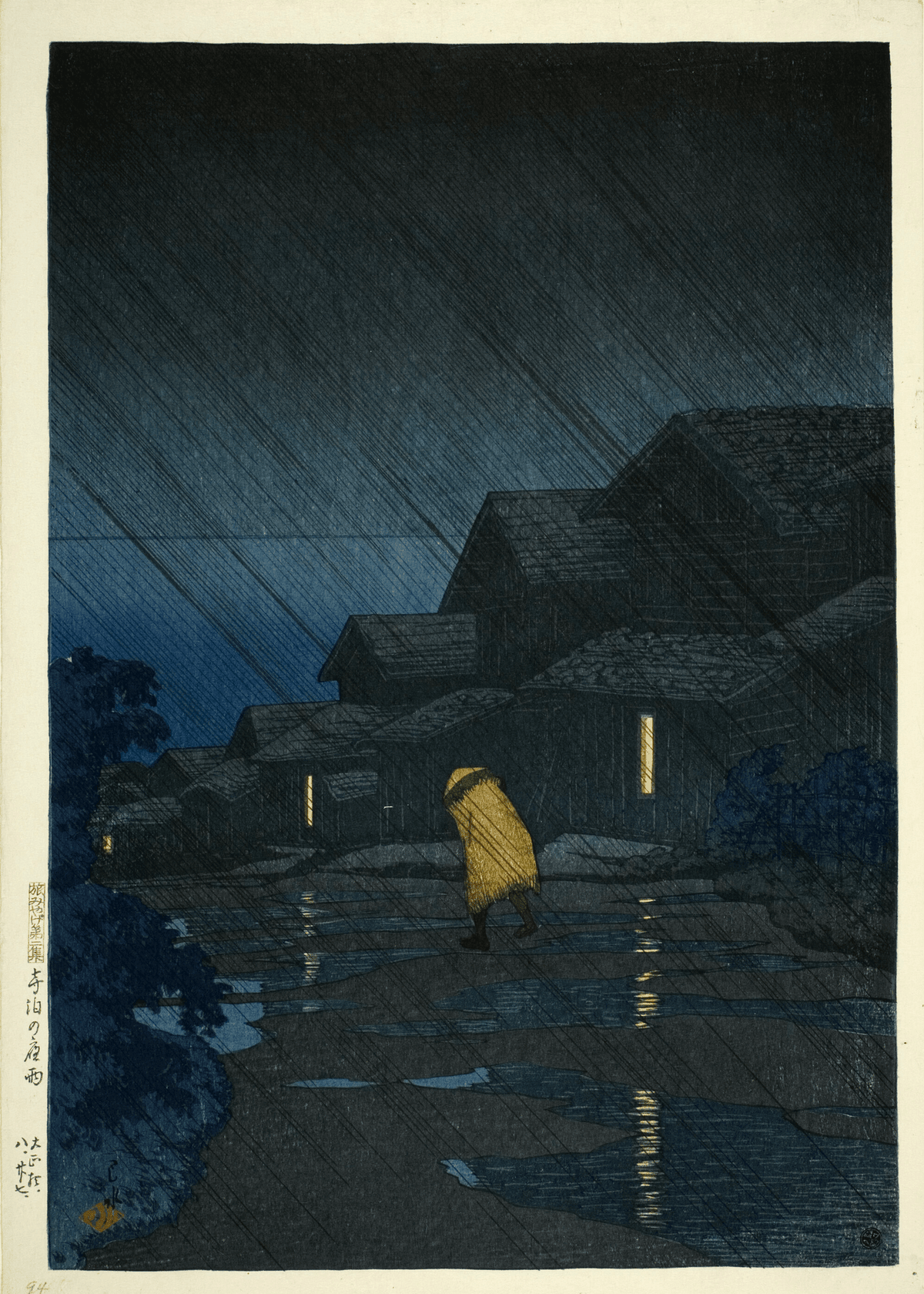
5. Kawase Hasui, Rain at Teradomari. Rain drawn as fine diagonal lines over grey water, with one warm point of lamplight. Narrow tonal range, low contrast, nothing to keep you awake.
Hallway, stairwell, entry — seen at walking pace
6. Kawase Hasui, Winter at Kamigamo, Kyoto. Mostly empty paper with a few dark verticals. It resolves in two seconds, which is all the time a hallway gives it.
7. Utagawa Hiroshige, The Teahouse with the View of Mt. Fuji at Zōshigaya. Hiroshige's landscapes have a graphic clarity that carries down a corridor, and Fuji in the distance gives the eye somewhere to land.
Kitchen, dining, small walls

8. Ohara Koson, Tits on Cherry Branch. Koson spent his career on kachō-e, bird-and-flower prints. Tall, narrow, mostly empty, built around one branch. These fit the awkward small walls other art cannot: between windows, beside a door, above a countertop.
9. Ohara Koson, Two Egrets in Flight. Buy two Koson prints rather than one. They were made as series and they hang as sets naturally — same format, same restraint, same palette family.
Study, reading corner, a room that needs warming
10. Inagaki Tomoo, Black Cat. Tomoo belonged to the sōsaku hanga, or “creative print”, movement, in which the artist carved and printed his own blocks, and he spent much of his career on cats. This one sits tall against a mustard-yellow ground and a pale moon, giving you a sideways look — humour without being cute, which is a narrow target to hit. The tall, narrow format suits the strip of wall beside a bookcase, and the black and grey hold their own in a room that is otherwise all books and dark wood.
Getting the size right
The original prints were small — oban size, roughly 39 by 26 centimetres. Reproducing them at that scale out of respect for the object is the single most common mistake, and it leaves a modern wall looking under-dressed.
Art above furniture generally wants to span 60 to 75 per cent of the furniture's width. These designs enlarge well precisely because they are flat colour with clean edges rather than fine brushwork — there is no detail to lose. Full guidance: What Art Print Size Should I Buy for My Sofa, Bed, or Dining Room Wall?
Getting the paper right
The original was pressed by hand into dampened paper, so the colour sits in a textured surface rather than on a smooth one. On glossy stock the image survives and the object does not. Ours are printed on Hahnemühle German Etching, 310 gsm textured fine art paper, with a twelve-ink archival pigment process — the texture is what makes a flat colour area read as printed rather than photographed. See What Paper Is Best for Art Prints? and What Does “Museum-Quality” Actually Mean?
Framing
Black and natural oak both work. Black suits the night and rain prints and the deeper palettes; oak suits snow, bird-and-flower prints and anything carried by empty paper. Avoid ornate gold — these prints have no interest in it. A mat adds breathing room to the smaller formats, which is usually worth it for Koson and Shinsui. See Should I Get My Art Print Mounted? and How to Frame Art Prints in 4 Easy Steps.
On why a well-chosen print lifts a room more than its price suggests, What Kind of Wall Art Makes a Home Look More Expensive? is the companion piece to this one.
Summary: Japanese woodblock prints suit modern rooms because they share its visual logic — flat colour, restraint, and real empty space. Start with shin hanga if you want calm, ukiyo-e if you want a focal point, choose by room rather than by artist, and buy one size up from your instinct.
Browse all Japanese woodblock prints
Or go by artist: Kawase Hasui · Hiroshi Yoshida · Ohara Koson · Utagawa Hiroshige · Ito Shinsui · Katsushika Hokusai · Shin Hanga Masters